Category: science projects

Slippery - Worm Bin (Weekly Unplugged Project)

By , June 17, 2009 10:09 pm

We have just added a new weapon to our arsenal against the heavy clay soil of Northern Arizona: our very own worm bin! In case you wonder what I am talking about, worm poop (more politically correctly known as “worm castings”) makes wonderful compost for the garden.

I didn’t pick the theme slippery with the worm bin in mind, but it occurred to me later that since worms are a bit slippery, this project fit the theme!

One option is to buy a commercially constructed worm bin such as this one, but I opted to go homemade (I guess this could have fit last week’s homemade theme too). Worm bins can be made out of wood or plastic containers. They can be one simple box or multilevel. I followed these online instructions for a two story, Cheap and Easy Worm Bin.

You’ll need two 8 to 10 gallon plastic storage boxes with lids (dark plastic, not transparent), a drill with a 1/4″ and a 1/16″ drill bit, some newspaper and a piece of cardboard.

First drill about 20 large (1/4″) holes in the bottoms of both boxes. Space them approximately evenly to allow for even airflow and easy worm travel.

Next drill small (1/16″) holes all around the top edge of the boxes, about 1 to 1.5″ apart. I did two rows for maximum ventilation.

Also drill small holes (about 30) in ONE lid. The other lid will be the base to collect any draining liquid, so don’t put holes in that one.

Fill a bucket or other plastic container with water. Tear the newspaper into long strips, approximately 1″ wide and toss them into the water to soak. This will be your worm bedding and you’ll want about 3 to 4″ of it in the bottom of the box. For us, it took one whole newspaper.


Take the newspaper strips out one handful at a time and squeeze them out well. They need to be nicely damp, not sopping (don’t forget that worms breathe through their skin so don’t drown them!).

Toss them in one of the boxes and fluff them up.

Once you have your 3 to 4″ of fluffed up bedding, you’ll need to mix in a bit of dirt. Since we still have a giant sand pile in the back yard, we put in a bit of sand too. Worms have gizzards and need to eat some of this rough material (dirt/sand) in order to digest their food (by grinding it in their gizzards - no teeth!).

Finally, soak a piece of cardboard just big enough to cover your bedding and place it on top of the bedding. The worms will be put underneath this cardboard and it will also become a tasty treat for them.

Now it’s time to set up your worm hotel. Place the solid lid upside down on the ground as a tray to catch any draining liquid from the decomposition process (known as “worm tea,” your garden will love this!). Place some bricks or blocks on the upside down lid as a base for the boxes (this allows for drainage). Next goes the empty box on top of the blocks, with the full box nested inside it. The lid with the air holes goes on top. Keep in a cool dark place.

When the worms move in, place their food in a corner and bury it under the newspaper to avoid odors and fruit flies. Bury new food in a different part of the bin each time you feed them. They will follow it around the bin.

Voilà! The finished worm bin! Now all we need are the residents. I ordered a 2 lb bag of Red Wigglers online and they should be arriving soon. At least their new home will be ready for them.

NOTE: Worms like: vegetables, fruit, tea bags, coffee filters and grounds, eggshells, bread, cereal, grains. Do NOT feed: meat, dairy, oil, fat, feces.

For more complete feeding information, as well as how to harvest your worm castings, please be sure to read the Cheap and Easy Worm Bin article!

LINKS:

Cheap and Easy Worm Bin

Worm Anatomy

Worm Composting (Vermicomposting) How-To

Vermicomposting

++++++++++

FOLLOW-UP: Be sure to check out the arrival of the resident worms in this post: Worm Bin Update - NO VACANCY

ALSO: Read about our first harvest (only 8 weeks later)

++++++++++


Homemade - Not So Perfect Taffy (Weekly Unplugged Project)

By , June 8, 2009 12:03 pm

The theme for this week’s Unplugged Project was homemade.

My children had been asking me recently about saltwater taffy, wanting to know what it was. I decided we should try to make some homemade taffy and have a taffy pull!

Well, as the title of my post suggests, this was not a tremendous success, but I am not giving up! I think I know what went wrong and am planning on trying again one of these days, so stay tuned for the post: “Taffy Part 2 - Perfect Taffy!”

I found a basic taffy recipe here, at this wonderful website: Science of Cooking. The recipe is under the category, Science of Candy.

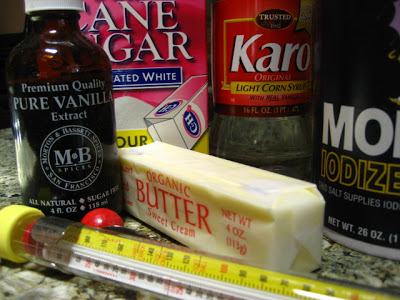
The ingredients are sugar, cornstarch, butter, salt, light corn syrup, water, and optionally: flavoring (we used vanilla extract) and food coloring. The recipe also gives the option of adding glycerin which will make it softer and creamier, but we left that out.

First we mixed together the sugar and cornstarch.

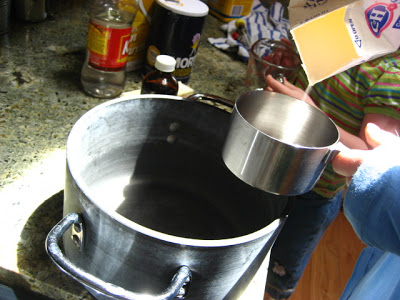
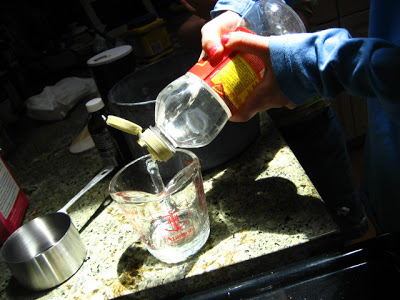
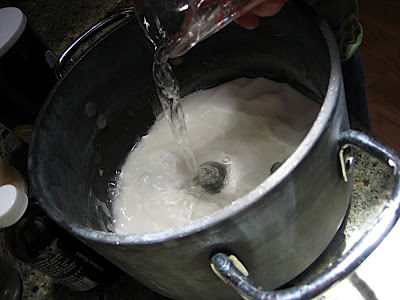
Next we stirred in the corn syrup, water, salt, and butter.

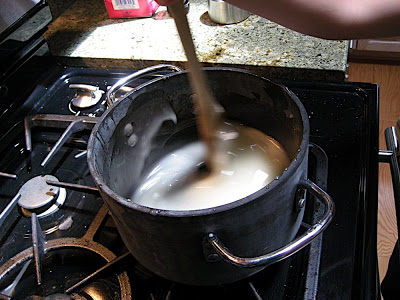
The whole mixture goes on medium heat. Constant stirring is required until the sugar dissolves, then continue stirring until the mixture boils. This step takes a while and the children grew a bit impatient, but from previous candy making experience, I know it is important to leave it on medium heat and not “cheat” by raising the temperature of the stove to hurry things along.

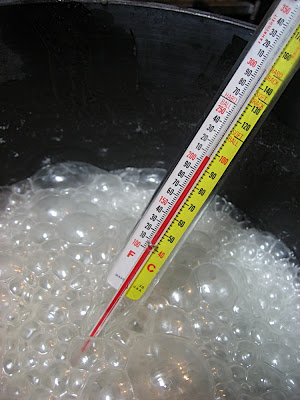
Once it boils, add a candy thermometer and stop stirring.

Why must you stop stirring? Here’s part of the science of this process:

“At this point, you have dissolved the crystal structure of the sugar. Stirring or other agitation is one of the many factors that can encourage the fructose and glucose molecules in your syrup to rejoin and form sucrose—crystals of table sugar.”

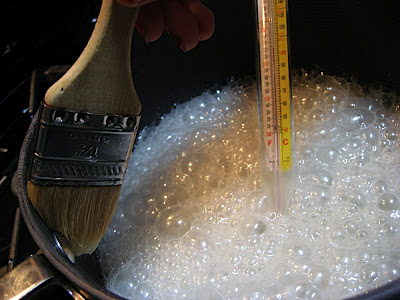
While the mixture boils, it is important to wash down the sides of the pan with warm water and a pastry brush. This prevents any crystallization on the side of the pan from falling back into the mixture and becoming a seed crystal which could also cause unwanted recrystallization of the sugar mixture.

OUR ERROR NUMBER 1: On the first attempt we forgot to wash down the sides of the pan which probably contributed to our rock hard result!

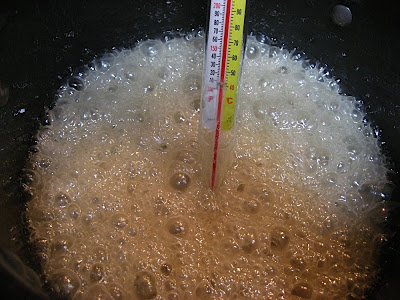
The recipe says to allow the mixture to heat to a temperature of 270 degrees Farenheit (the “soft-crack” stage). At this point you will notice that the bubbles are smaller, thicker and closer together. Here is what it looks like:

At this point quickly stir in your flavor and color should you choose to add any, then dump the very hot liquid onto a greased cookie sheet, or marble slab. I just buttered our granite countertop and that worked nicely. Warn the children that it is VERY HOT.

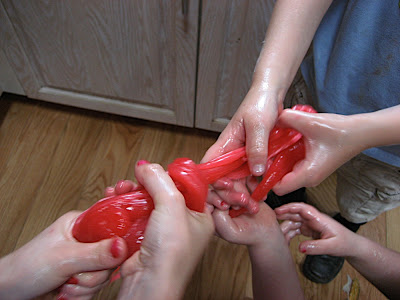
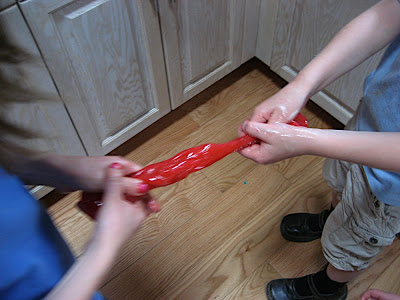
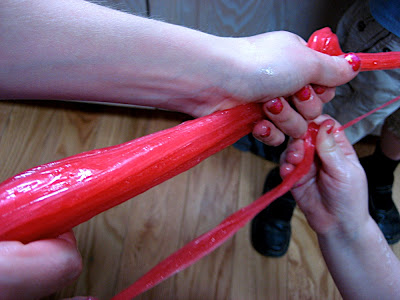
Have the children butter their hands (they loved this step), and when it is cool enough to handle, begin the pulling process. Have the children stretch it between them (warning - DO NOT DO THIS ABOVE A DOG. Our dog jumped up and bit some off!).

Once it is stretched, then they should fold it in half (like folding a sheet), turn it and stretch again.

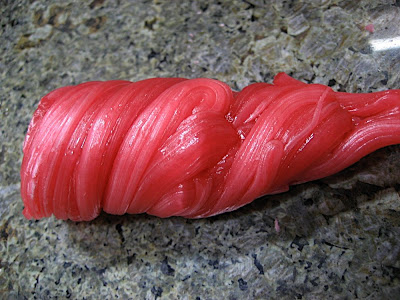
Here is where it all began to go wrong for us on our second taffy attempt. Normally the taffy should become harder and harder to pull, but keep on going until it is “light in color and has a satiny gloss” (about 10 to 20 minutes according to the recipe). Ours got stiff and nearly rock hard in less than 5 minutes.

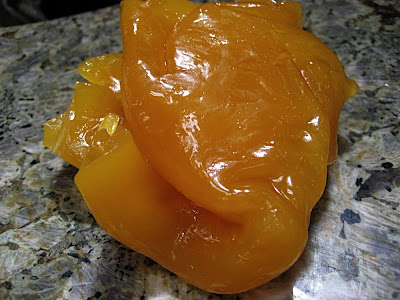
RESULT NUMBER 1 - An interesting geological specimen:

RESULT NUMBER 2 - A little softer, but still capable of killing an intruder with a single blow:

Oh well. At least it tasted good (like butterscotch!).

Here is where I’ll stop my narrative since we got no farther. The recipe continues on to explain how to cut it into pieces and wrap it (we would have needed a power saw).

OUR ERROR NUMBER 2: On the first try, we heated to 270 degrees, but it took me a minute or two to get the food coloring and flavor in there, so it might have gone a bit above (the temperature rises very quickly when it gets that hot). Result: Rock hard lump, like a giant hard candy rock!

On the second try, I only heated to 260 degrees and worked much more quickly with the color and flavor. Result: Pliable at first (we thought it was going to work), but as the kids pulled, it got harder and harder until it was unworkable and was only slightly softer than the first try - still a hard lump.

My realization: We live at an elevation of about 8,000 feet above sea level. I had not taken this into consideration when determining the temperature at which to stop the cooking! In order to avoid over-cooking, we probably need to heat to only about 240 degrees.

WHAT WE LEARNED: Altitude affects cooking time because water boils at a lower temperature here than it does at sea level (due to lower air pressure up high). Pasta always takes about 3 minutes longer to cook here than the maximum time given on the box. The candy was boiling earlier (at a lower temperature) so it boiled much longer than it should have by the time it reached 270 degrees. The molecular change was farther advanced at that temperature than it would have been at sea level, making for harder candy (more like “hard-crack”). Any other high altitude cooks out there might be interested in this link that I discovered about adjusting candy temperatures for altitude: Candy Making Tips (scroll down to the very last paragraph for the high-altitude conversion).

As I said before, I want to try this again and I think we’ll have better luck. I’ll be sure to post a photo of our “perfect taffy!”

++++++++++

Did you do a homemade Unplugged Project this week? If so, then please put a link to your post in the Mr. Linky below. You had also better leave one in a comment too, since Mr. Linky has been acting up lately. If you did not do a homemade project, then please do not link, but read more here about how to join in. We’d love to have you!

Next week’s Unplugged Project theme will be:

Slippery

Enjoy!

++++++++++

Powder - Baking Soda Boats (Weekly Unplugged Project)

By , May 3, 2009 7:22 pm

The theme for this week’s Unplugged Project was powder. I’ll admit that this particular choice was somewhat premeditated since I thought a baking soda project would be fun. Baking soda is a powder, right?

Fondly remembering a baking soda boat that came in a cereal box once when I was a child, I suggested we try and make one. My children were enthusiastic but leery, remembering a particularly violent baking soda volcano we made one time!

I am sure they were rolling their eyes and thinking:

“Oh no, here goes Mom with the baking soda again.”

Is that what they’ll remember about me as adults?

“I don’t remember much about Mom, but she did like playing with baking soda and vinegar.”

I found instructions here on the PBS Zoom website for a boat made out of a plastic bottle. Never being able to simply do what instructions say, I had to experiment, so we tried a sippy cup boat too!

We needed baking soda, vinegar, and our bottle and cup.

Using a hammer and nail, we made a hole in the cap of the bottle. The hole is the exhaust pipe through which the carbon dioxide gas escapes propelling the “boat” through the water.

The sippy cup already had holes of course, but I covered up the vent hole with some masking tape so the only vents would be in the spout.

Supplies in hand, we eagerly headed off to the bathroom and put some water in the bathtub.

The Zoom website suggested wrapping the baking soda in toilet paper to slow the reaction. Remembering my volcano, I thought this might be wise advice.

We poured baking soda onto a strip of toilet paper:

And rolled it up:

We tried the sippy cup first and poured in some vinegar.

Next we put in a few marbles to weigh down the spout (where the “exhaust holes” are), so it would be underwater. Coins work too. It is important that the exhaust holes be under the water line so there will be more resistance (of the water) to propel the boat.

The kids cringed when I dropped in the toilet paper package containing the baking soda.

I quickly put the cap on and placed the cup in the tub. The cup whizzed around the tub accompanied by many oohs and aahs.

The toilet paper worked nicely to delay the reaction giving me time to put the top on, but on the second attempt the toilet paper clogged the exhaust hole stopping the “boat.”

We tried the bottle too. Same procedure: vinegar, toilet paper/baking soda and marbles. The bottle sailed around the tub.

Since we were having clogging problems with the toilet paper, we also got brave and dumped the baking soda in, poured in some vinegar and tried to get the top on quickly. Unfortunately we were never able to be quick enough, and those boats didn’t work as well since, as you can see here, a large part of the chemical reaction occurred before the top was on.

In light of my baking soda and vinegar obsession, this could become quite a project: how to control the reaction without clogging, what sized hole produces the best results, what proportions of baking soda and vinegar generate the most power. Nerd heaven! Look out for a blog post one day with my perfected version of this project.

My kids went on to create their own experiment with baking soda and vinegar in a plastic wipe box:

Fortunately we ran out of baking soda before they were able to blow the box open!

++++++++++

LINKS:

Chemistry and ideas: Baking Soda and Vinegar Science

Real Science: Ask a Scientist-Vinegar and Baking Soda

++++++++++

Did you join us this week for a powder Unplugged Project? If so, please link to your powder project post (not your blog) below. If you didn’t join in, then please don’t link but read more about how it all works here. We’d love to have you!

++++++++++

The theme for next week’s Unplugged Project will be:

Magic

Have fun!

++++++++++

Science - Weekly Unplugged Project

By , April 19, 2009 9:36 pm

Oh, I had better get this up now before Turnoff Week starts tomorrow and we are all supposed to try not to be on the computer!

The theme for this week’s Unplugged Project was science. I actually have something to post about science, but I didn’t get to it today. Perhaps I will post tomorrow, but I’ll try and post quickly!! I’ll link to it in Mr. Linky below if I get to it.

If you have a science Unplugged Project to post, please link to your project post in Mr. Linky below. If you didn’t do a science project, but want to join in in the future, please read more about the Unplugged Project here. We’d love to have you!

The theme for next week’s Unplugged Project will be:

Yellow

Have fun!

PS: It’s not too late to join in the Turnoff Week Blog Challenge for a chance to win a $10 Amazon gift certificate (Turnoff Week is April 20 - 26). Read here for more information!

Float - Toy Parachute (Weekly Unplugged Project)

By , February 8, 2009 8:44 pm

I guess I must have picked float as the theme for this week’s Unplugged Project because last week’s marbleizing project involved floating a piece of paper in a baking tray of water. Well, I won’t do that again, because all I could think of all week long were ideas very similar to our marbleizing project. I was completely without inspiration.

Then this boring, snowy Sunday, as the kids were playing Calico Critters, I suddenly had the inspiration to try making a Calico Critter parachute. Parachutes float (…hopefully…)!

We gathered together some scarves of different sizes and fabrics to experiment with, some items for the “cockpit” (a small basket and a little nylon pouch that originally contained some fiberfill stuffing - I am glad to be a packrat, I knew that pouch would come in handy one day!), yarn, scissors, and a couple of fearless test-pilots:

First we cut four pieces of yarn all the same length. Then we tied one piece of yarn onto each corner of the scarf:

Next we attached our basket and pouch. In an effort to take weight into consideration, we decided to put the pouch on the cotton bandanna because the bandanna was heavier than the play silk and the pouch was lighter than the basket.

We tied the strings onto the pouch by bunching up the fabric just as we had done with the scarf.

We tied the basket on with a string on each handle and a string on each side in the middle in order to keep it as well-balanced as possible:

NOTE: Be careful tying the strings onto your “cockpit.” You want to keep them in order so that aren’t twisted and it can get a bit confusing, especially if your cloth is big and your strings long.

Also, you could simply tie your object directly on to the strings without having a container. I think it is more fun with a basket or a pouch though, that makes it much easier for children to experiment with different objects and toys.

The cats found this project to be particularly appealing. Strings plus soft things to lie on meant 5-star kitty excitement:

In popped the intrepid test-pilots, and off we went to the upstairs landing for launch.

Make sure you hold the parachute by pinching it in the center and dangling it all over the edge of the railing before dropping. Also, for best performance, the strings should not be twisted or tangled.

The bandanna went first - success!

Next was the playsilk. It didn’t crash, but it went down pretty fast. I thought that it might be because of the air flowing through the holes in the basket.

We lined the basket with a paper napkin and the second launch was perfect! The parachute floated gracefully down to the ground.

I am pleased to report that no Calico Critters were injured in the testing of the parachutes.

If you are curious, here’s a 5 second video of our silk parachute:

Link: How does a parachute work?

++++++++++

If you did a float Unplugged Project this week, please put your link in Mr. Linky below (link to your post, not just your blog please so your post will always be easy to find). It’s also wise to leave a comment so if Mr. Linky ever disappears, you won’t disappear with it! If you did not join in, then please do not link, but read more about how to join in here.

I am trying to visit at least a few projects every week, but I can’t always get to everyone anymore. I feel a bit bad about that, but blogging is not a full-time occupation for me, so I guess I can only do my best. I hope you all understand!

++++++++++

The theme for next week’s Unplugged Project, will be:

Wrinkle

Have fun!

++++++++++

Blog Widget by LinkWithin

Panorama Theme by Themocracy