Category: older children

Early Readers: Pirate Adventures!

By , February 26, 2009 9:26 pm

In my never ending quest for good early readers, I recently stumbled upon this “treasure” for pirate-loving boys: Treasure Island - Easy Reader Classics Series. I bought the first two of the set of four for my 6 year-old son who was in need of some interesting reading material.

My son is currently at that awkward, in-between phase of reading acquisition. Even the most advanced Bob Books and other phonics-style readers are too easy and boring, but full-on chapter books are a bit too hard and could lead to frustration.

This Treasure Island series seemed to be just the ticket. Each book is part of an ultra-simplified and abridged version of the classic adventure tale by Robert Louis Stevenson. They describe the adventures of a boy named Jim who, after finding an old treasure map, winds up on a ship in search of the lost treasure. Of course Jim must outwit the pirates who are also seeking the treasure. Is this not the dream of many young boys out there?

My son LOVED the first two books so much (he read them immediately one after the other), that I had to get online right away and order the last two. I am not exaggerating when I say that he was literally counting the days until his books arrived. When they did, he ripped open the box and devoured them both right away. Any book that has that sort of effect on my new-reader son gets my 5 star recommendation!!

There are other Easy Reader Classics series too: The Adventures of Tom Sawyer, The Jungle Book, The Story of Doctor Dolittle, and The Wind in the Willows. We’ll definitely be trying another set soon, especially since they are all currently part of the Amazon 4-for-3 promotion (that means you can get all four books in a series for the price of three).

Reading Level Facts:

  • Each book is 32 pages long and is divided into four chapters so young readers can feel that they are reading a true “chapter book.”
  • The type is fairly large and there are just a few sentences on each page which is a perfect layout for short, young attention spans.
  • There are many large, colorful illustrations that I actually found to be somewhat mediocre in quality, but my son didn’t seem to mind.

Here are some photos to help you judge the level of difficulty for yourselves:

Betsy-Tacy (Maud Hart Lovelace) - Another Great Chapter Book

By , February 17, 2009 10:44 pm

I find so much good stuff by surfing Amazon! Having no “real” bookstore here and only a tiny library, it is one of my best ways for discovering great books.

One of our latest wonderful reads is Betsy-Tacy by Maud Hart Lovelace. I believe it is something of a classic although it was new to me. Hopefully I am not demonstrating my ignorance of classic children’s literature by recommending it, but recommend it I do!
The story revolves around two five year old neighbors, Betsy and Tacy, who become such inseparable friends, that the title of the book must be Betsy-Tacy (rather than Betsy and Tacy, get it?):

“Betsy’s brown braids went with Tacy’s red curls, Betsy’s plump legs with Tacy’s spindly ones…” (p.1)

Betsy is outgoing, Tacy is shy. But, after a rocky start, opposites do attract and the pair become a “unit” as suggested by the title.

The girls enjoy simple adventures, mostly involving a lot of imagination. It is all very sweet and innocent and charming. There is nothing that I could find to scare particularly sensitive readers. Even I enjoyed reading a bit further along every night before bedtime.

The only potentially upsetting moment is when Tacy’s baby sister dies of an illness. The episode is not really about Baby Bee, but the focus is on how Betsy sweetly comforts sad Tacy. It was well-handled and my rather sensitive children were not upset by it at all.

The author Maud Hart Lovelace was born in Mankato, Minnesota in 1892. This series of books is about her memories of her childhood, “…the happiest childhood a child could possibly know…” (quote from Maud Hart Lovelace, inside of back cover).

The author is Betsy, right down to the straight hair that wouldn’t curl. Her lifelong best friend Frances Kenney (known as “Bick” - baby-talk for “Brick” - due to her red curls) is the model for Tacy. The pair met at Maud’s 5th birthday party, just as Betsy and Tacy meet at Betsy’s 5th birthday.

The book has a very interesting section at the end about Maud Hart Lovelace and her life, complete with some photos of both her and “Bick.” For even more information, there is a Betsy-Tacy Society in Mankato with its own website: www.betsy-tacysociety.org. If you want to, you can even attend their Betsy-Tacy Convention from July 17-20, 2009 in Mankato, MN.

DETAILS - 14 Chapters plus author information, 122 pages, fairly large type-face, some line-drawn illustrations.

Hmmm…..I guess these books are way more popular than I realized.

Enjoy!

PS. We’ll be reading all the others ASAP. By the way, although these books would obviously appeal to girls, my 6 year-old son was just as captivated as his 8 year-old sister. If you have a young boy, you might want to try one from the library because he just might love it also!

Here are all the books in order:

1940′s Innocence - Maj Lindman’s Series (Chapter Books Suitable for Extra-Young Readers)

By , October 16, 2008 1:39 pm

I am on a roll with Swedish children’s books after last week’s recommendation of Astrid Lindgren’s The Children of Noisy Village and Happy Times in Noisy Village. That post reminded me of Maj Lindman’s two lovely series: Flicka, Ricka, Dicka and Snipp, Snapp, Snurr.

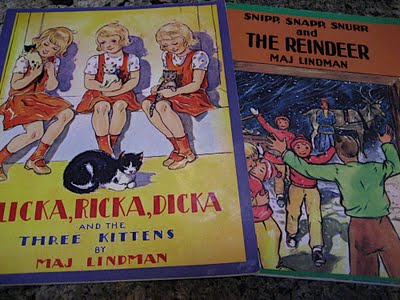
Don’t you love it when you wander into a thrift store and discover something wonderful? I know I do. It always brightens my day when that happens. Snipp, Snapp, Snurr, and the Reindeer and Flicka, Ricka, Dicka and the Three Kittens were that kind of happy thrift store find!

The Snipp, Snap, Snurr series (first published in the U.S. in 1957) is about three adventurous little Swedish boys in, I would estimate, the 1930′s or ’40′s. Although the books seem to be written with boys in mind, my daughters love them too.

The Flicka, Ricka, Dicka books (first U.S. publication was 1941) are about (you guessed it!) three adventurous little Swedish girls of that era. Again, although targeted toward girls, my son loves these books as much as his sisters do.

The books are short, about 24 pages each. Since each two page spread includes one page of text (in very large type) and a wonderful Maj Lindman 1950′s-style illustration on the facing page, there are really only 12 pages of text per book. There are no chapters, but these are entirely suitable for beginning chapter book readers since they are so short and fairly simple:

Each book involves an innocent adventure with a little bit of minor drama (boys lost in the snow, a missing cat, etc.) that is, of course, always happily resolved. None of it is too suspenseful or frightening which makes it appropriate for even the youngest new readers.

Also, if you don’t mind buying from Amazon, they are all part of the 4-for-3 promotion so you could get four of these wonderful Maj Lindman books for the price of three!

Our first two:

The others (those that are easily available in the U.S.):

Snipp, Snapp, Snurr -

Flicka, Ricka, Dicka -

Chapter Books Suitable For Extra-Young Readers (Book Review - Part 3)

By , October 8, 2008 9:06 pm

When you have a child who is reading very well at an early age, it can sometimes be difficult to find books that are challenging enough for your young reader, yet innocent enough for a child who is not ready for more mature subject matter.

I have a few suggestions. If you have not yet read Parts 1 and 2 of this series, then please head on over for some other ideas.

This week, I want to mention another lesser known set of books that we just adore. These would appeal to boys as much as to girls.

I already reviewed the first book in the series a long time ago, so I feel a bit like I am cheating. But things get buried in a blog and I MUST mention this series again because I think it is so wonderful!

This week’s suggestion is the “Noisy Village” series, by Astrid Lindgren (most commonly recognized as the author of the well-known Pippi Longstocking series).

I desperately wish there were more, but the series consists of only two chapter books: The Children of Noisy Village and Happy Times in Noisy Village.

There are also two short picture books (32 pages): Christmas in Noisy Village, and Springtime in Noisy Village (which is harder to come by).

The very charming Children of Noisy Village is actually one of the first chapter books I ever read out loud to my two oldest children. We sat on the sofa in front of the fire on a boring, snowy Sunday and all three of us laughed out loud at the funny adventures of the Noisy Village children. Much to my delight, I even found a bit of more subtle humor in the book that escaped my children. These moments kept me wanting to turn the pages as much as my children did.

In case you missed my first review, the three Swedish farm houses that comprise “Noisy Village” are inhabited by a pack of mischievous children ages 9 to 11 (as well as a baby or two). The tale is very convincingly narrated in the first person by 9 year-old Lisa.

The era of the book is never specified, but according to the “About the Author” section, Astrid Lindgren’s writing was greatly influenced by her childhood on a small Swedish farm. Since she was born in 1931, that would probably place the setting of this book sometime around 1940.

None of these simple adventures are mean or malicious, but are completely innocent and charming. I was also struck by the fact that the children never talk back, or act in a disrespectful manner to each other or their parents, as I find to be the case with many books of this genre nowadays.

If you read these books out loud, make sure you have plenty of time since you might be begged to read them cover to cover in one sitting.

For silent-reading I would place them on the same level of complexity as the Fairchild Family books by Rebecca Caudill that I reviewed last time. That is, not suitable for beginners, but perhaps not quite as advanced as the The Little House series.

More details to help you determine the suitability for your child: each of the two chapter books is about 120 pages long and is divided into 14 chapters. Typeface is medium and there are quite a few sweet line drawing illustrations (by Ilon Wikland) scattered throughout the book.

The only picture book I have seen is the Christmas one. I don’t like it as much as the chapter books. There are more illustrations, and they are in bright colors. Somehow, I prefer the subdued black and white line drawings of the originals.

Also, although the story is fun in the short Christmas book, there is a scene where one of the older boys pretends to be Santa and brings in the gifts. In my mind, this brought up the whole “is Santa real” question. Fortunately however, it seemed to escape my children and we didn’t have to address that issue. The Christmas chapter in The Children of Noisy Village was different and didn’t venture into such perilous territory.

Conclusion: I can’t recommend these chapter books enough, for both girls and boys!

Chapter Books Suitable for Extra-Young Readers (Book Review - Part 2)

By , September 17, 2008 9:58 pm

With 10 comments and 135 page views so far, it seems that people really liked the first post in my new Chapter Books Suitable for Extra-Young Readers series! Perhaps I shall have to make this a regular weekly feature at Unplug Your Kids rather than simply stop at the three posts that I had in mind. I’ll certainly run out of ideas eventually, but I do have quite a few to share.

If you are interested in this subject, then I urge you to read all the wonderful comments I received last week on Part 1. Many of you left suggestions of “nice” chapter books that you or your children have enjoyed, and I am so grateful for the helpful input! You even reminded me of a few that I had enjoyed as a child and forgotten about. Thank you!

My plan for this week was to mention another book (again, part of a great series) that I was lucky enough to discover at the thrift store:

Happy Little Family (Fairchild Family Story)by Rebecca Caudill

My children fondly refer to this series as “The Bonnie Books.” When we are reading one of these at bedtime, they shout “Let’s read about Bonnie!!!”

The books are about a family of five children and their poor but happy life in the mountains of Kentucky at an indeterminate era (early 1900′s judging by the autobiographical aspect and the fact that author Rebecca Caudill - real name: Mrs. James S. Ayars - was born in 1899).

The series is about the whole family, although it does focus mostly on 4 year-old Bonnie, the youngest of the five Fairchild children. My two oldest children are endlessly amused by the similarity between Bonnie and their own little two and half year old sister.

Happy Little Family is the first book of this series of four Fairchild family stories. The books are very reminiscent of the Little House series: horse-drawn wagons, the excitement of a pair of shoes or a trip to town, a one room school house, adventures in the woods… but no prairie since this is Kentucky.

Plus, while the Little House books do have a few suspenseful episodes that might be difficult for particularly young and sensitive types to enjoy, we have read two of the Fairchild series so far, and I cannot recall anything remotely frightening taking place in either of them.

Book 1 is Happy Little Family . It consists of various amusing, sweet, and simple adventures of the Fairchild children.

Book 2, Schoolhouse in the Woods, has a more specific theme: a Fairchild family school year in their one room school house, and most importantly - little Bonnie’s very first year of school. (By the way, the school “year” only went from August through Christmas. In January and February the weather was too snowy to make the long walk to school, in March and April it was too rainy, and May through July were busy times on the farm and the children had to stay home and help.)

By popular demand, I am on my way to order Book 3: Up And Down The River

Each of these books is around 120 pages long. Type-face is medium, and there are 5 chapters in Happy Little Family, and 7 in Schoolhouse in the Woods . This series is definitely for more advanced readers than Cynthia Rylant’s Cobble Street Cousins series that I reviewed last week, however I think it might be a small step below the Little House books.

These are also an excellent choice for a sweet read-aloud and my 6 year-old son enjoys them as much as my 8 year-old daughter.

Here are the books in order, but they needn’t be read in order:

Book 1: Happy Little Family
Book 2: Schoolhouse in the Woods
Book 3: Up And Down The River
Book 4: Schoolroom in the Parlor

If you prefer a visual, here are the covers!

Please come back next week for Part 3 of this series!

AN AFTERTHOUGHT: Rebecca Caudill also wrote one of my favorite childhood easy chapter books (I loved it so much that I kept it and it now resides on my daughter’s bookshelf!): The Best-Loved Doll. This is a shorter and much easier chapter book, more like Cobblestreet Cousins in difficulty. It deserves it’s own post one day, but I thought I should also mention it here.

Blog Widget by LinkWithin

Fight World Hunger

Panorama Theme by Themocracy
