Category: educational/homeschool

Random Acts of Kindness

By , February 16, 2011 12:08 pm

Apparently it is Random Acts of Kindness Week. Who knew?

But now seems like an excellent time to teach your children about Random Acts of Kindness (RAK) and the concept of Pay it Forward. I just gave a successful class on this very subject at my children’s Montessori School and here is what I suggest:

  • Make sure everyone understands what the words “random” and “act of kindness” mean.
  • Read the book Because Brian Hugged His Mother by David L. Rice (illustrated by Kathryn Dyble Thompson). An excellent introduction to the concept of “Pay it Forward” in a story that children can relate to (NOTE: I have LOVED this book for a long time. If you want, please read my review).
  • Suggest some easy things kids can do to make a positive difference in someone’s day. Here are a few:
    • Smile at someone :-)
    • Hold a door open for someone
    • Do a daily chore normally performed by a sibling
    • Do a household chore without being asked: feed dog, do the dirty dishes you see in sink, etc.
    • Leave your change in the soda machine for someone else to find
    • Shovel your neighbors’ steps
    • Plant a seed
  • Have the kids brainstorm some more easy ideas.
  • Let them give it a try. Give them one week to complete one RAK and report back on what they did and the outcome (how it felt, consequences to them if any, etc.).

HELPFUL LINKS:

Random Acts of Kindness Foundation

Kid Activities - Acts of Kindness

HelpOthers.org - Kindness Ideas

[Image thanks to Kid Activities!]

Invisible Ink Messages (“Messages” Unplugged Project)

By , January 23, 2011 4:00 pm

All spies love invisible ink. In honor of this month’s Unplugged Project theme of messages here are two simple methods for making secret, invisible ink messages out of ordinary ingredients.

++++++++++

LEMON JUICE:

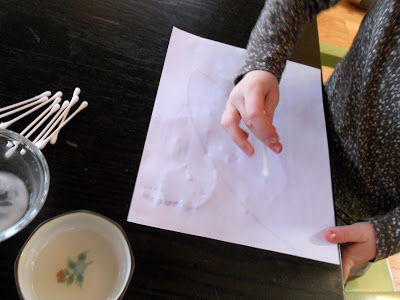
Either squeeze a lemon or be lazy like me and use that store bought lemon juice that comes in the little plastic lemon! Put the juice in a small dish and use a cotton swab to write your secret message.

++++++++++

BAKING SODA & WATER:

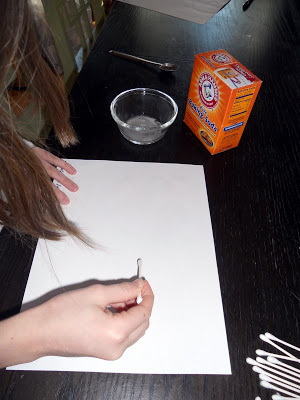
Mix together equal parts baking soda and water in a small bowl. Again, use a cotton swab to create your message.

++++++++++

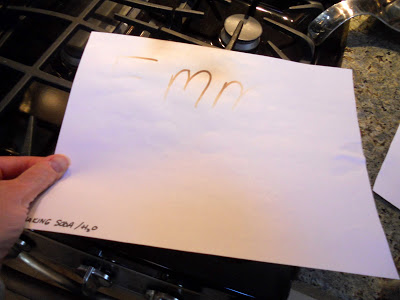
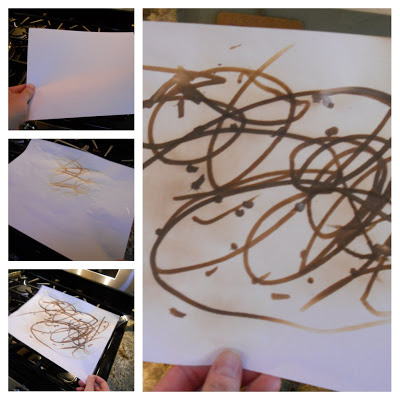
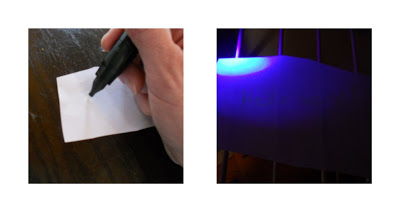
Once the messages are completely dry and can no longer be seen on the paper, hold the paper over a heat source and the message will magically be revealed to guaranteed “oohs and aahs!” (Obviously an adult should complete this step, especially with young children, so as to avoid burns and flaming paper.)

By the way, we found that the baking soda produced a slightly darker result than the lemon juice.

NOTE:

For those whose children channel James Bond rather than Martha Stewart, a high-tech invisible ink spy pen complete with built-in ultraviolet decoding light might be just the ticket. My son found this one in his Christmas stocking:

LINKS - More about invisible ink:
The Naked Scientist - Secret Messages-What Makes an Invisible Ink?
Kidzworld-How Invisible Ink Works
Science Project Ideas - Invisible Ink (this site has some other interesting methods too)

Secret Codes: The Cardan Grille (“Messages” Unplugged Project)

By , January 10, 2011 2:39 pm


My two oldest children are really into secret codes at the moment and when I asked them for suggestions for this month’s Unplugged Project theme, my 8 year-old son immediately said “Messages! We could make codes!”

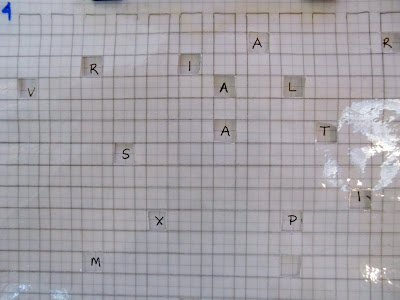
So here is our first code, a version of the famous code known as the Cardan Grille. For this code, a special template is used to encode and decode a message. Here’s how we made ours:

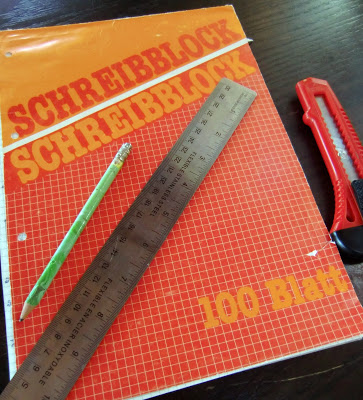
You’ll need paper (graph paper makes it much easier), a sharp pencil, scissors, a ruler, and a box cutter or razor blade.

First mark out evenly spaced boxes on your graph paper. You will be cutting some of these into square openings, so you’ll have to leave some blank space around each box. (Our boxes were two graph squares wide and two squares tall with one blank square between rows.)

First we marked off rows of squares then we drew the grid using the ruler.

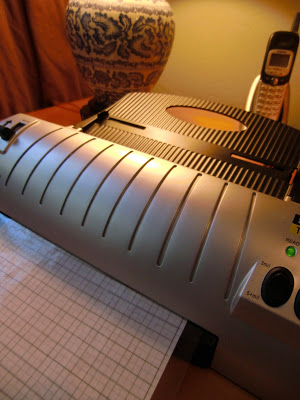
Next we laminated our paper. If you don’t have a laminator, you might want to paste it to some stiff cardboard or posterboard just to make it tougher. If the grid gets lost or destroyed, no one can crack the code and you will be fired as a secret agent!

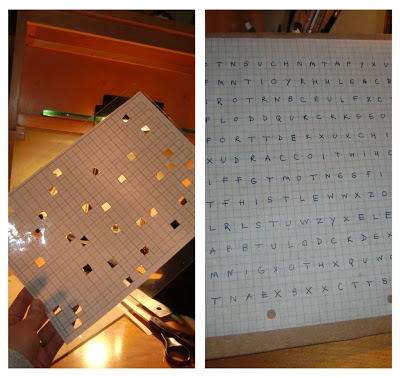
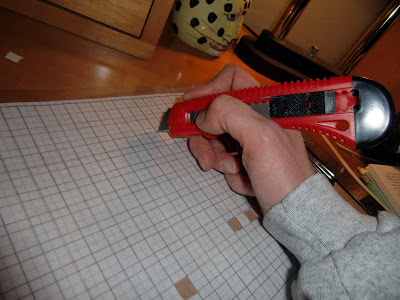
I used a box cutter to cut random squares out of the grid. I put an old wooden clipboard underneath in order to avoid damaging the desk. You could use pointy scissors for this step, but a razor-type blade makes the job much easier. (Obviously, an adult should do this step.)

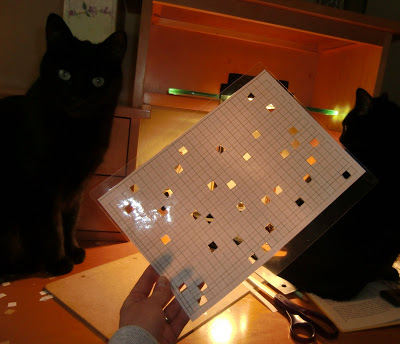
The finished template (with my “helpers” in the background):

Now you are ready to encode. Place the template over a fresh sheet of paper. Mark around the corners with a pen to make it easier for the decoding person to line it up. Write your message (one letter goes in each square).

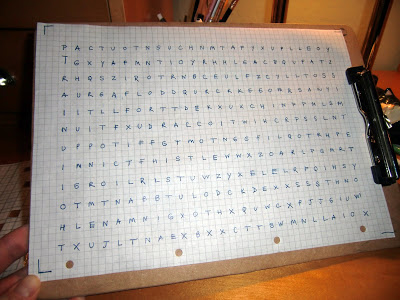
Remove the template and fill in all the open squares with random letters. Can you figure out what this says?

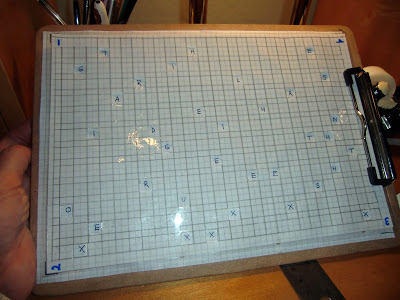
Here is the solution:

(“The girls are hiding the treehouse.” - OK, so it was supposed to say “The girls are hiding in the treehouse but we forgot the “in.” But coded messages are supposed to be brief, right?)

NOTES:

  • You can make your template as big or as small as you like.
  • For ease of communication between spies, you really ought to make a duplicate template so both sender and recipient have their own. Just place the first template over a new piece of paper, trace the locations of the squares, laminate, and cut out.
  • I numbered the corners of the template 1 - 8 because you could use both sides and all four orientations to create different messages, or even one long one.
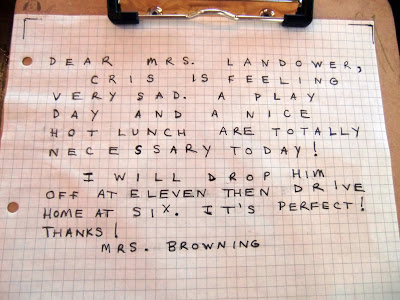
  • Traditionally, the template was placed over an ordinary letter (see the example here) but it can be very challenging to come up with a natural sounding message built around the coded text. I gave it a try though and it was a fun mental exercise:

(“Arrival at six PM.”)

Watch the Perseid Meteors Tonight

By , August 14, 2010 2:53 pm

Last night I woke my two oldest children up at 2:30AM. I led my confused and sleepy babies out onto the golf course behind our house armed with a flashlight and a blanket. I spread out the blanket on the cool, damp grass of the fairway, we all laid on it facing northeast … and hoped that the sprinklers would not go off! Lol!

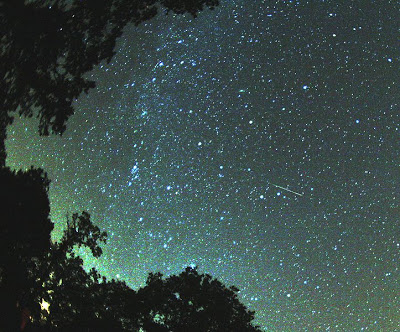
The children were astonished by what they saw - shooting stars, lots of them! We also saw the Milky Way and several satellites marching in line across the night sky.

Our fabulous unplugged (and free!) show was the annual Perseid Meteor Shower. The peak was the nights of August 12 and 13th, but you might still be able to see a pretty good display through the 22nd (especially if you are lucky enough to live in a low ambient light area like we do). Just look to the northeast after midnight.

PS. Most visible in the Northern Hemisphere, sorry!

LINKS:

EarthSky’s Meteor Shower Guide

Excellent Perseid Meteor Shower Expected

How-To: Photographing the Perseid Meteor Shower

Perseid Photo Gallery

For another of our astronomy adventures, you might like to read: The Moon Unplugged? Not For Me!! (Part 1) and Mom Unplugged vs. Evil Sleepy Poser Mom - Lunar Dilemma Part 2.

++++++++++++++++

(PHOTO: I wish I had taken this great Perseid photo, but it is the work of Mila Zinkova. License information can be found here.)

Quick, Fun & Free Road Trip Idea

By , June 12, 2010 8:58 am

License Plate Scavenger Hunt

  • Download and print a free, printable map of the US (or your country/region).
  • Give one to each of your children and see how many license plates they can spot while on the road.
  • They can color in the states as they spot them.
  • For US mainlanders, a special prize for Alaska or Hawaii makes it even more fun.

The map format (vs. just a list) gives them a real sense of geography. On a recent road trip, I found my kids saying things like: “The farthest state we have seen from where we are now is New York” or “Look! We have all the states that border Arizona!”

TIPS - For extra learning, choose one with state capitals*. Younger children will just enjoy coloring the map.

* For a printable PDF file of a US map with state capitals (free for personal or classroom use), go to this site, scroll down, and click on the link “United States: Capitals.”

(Photo from Wikimedia Commons. Licensing and author information here.)
Blog Widget by LinkWithin

Panorama Theme by Themocracy