Posts tagged: imaginary play

Secret Codes: The Cardan Grille (“Messages” Unplugged Project)

By , January 10, 2011 2:39 pm


My two oldest children are really into secret codes at the moment and when I asked them for suggestions for this month’s Unplugged Project theme, my 8 year-old son immediately said “Messages! We could make codes!”

So here is our first code, a version of the famous code known as the Cardan Grille. For this code, a special template is used to encode and decode a message. Here’s how we made ours:

You’ll need paper (graph paper makes it much easier), a sharp pencil, scissors, a ruler, and a box cutter or razor blade.
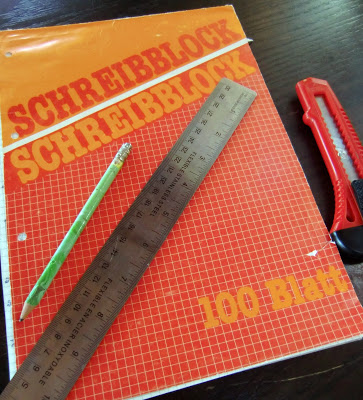
First mark out evenly spaced boxes on your graph paper. You will be cutting some of these into square openings, so you’ll have to leave some blank space around each box. (Our boxes were two graph squares wide and two squares tall with one blank square between rows.)

First we marked off rows of squares then we drew the grid using the ruler.

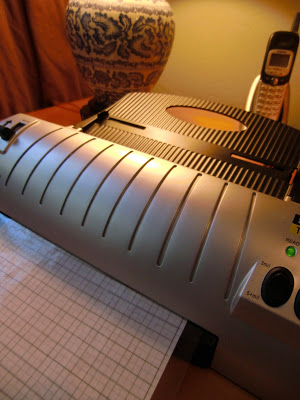
Next we laminated our paper. If you don’t have a laminator, you might want to paste it to some stiff cardboard or posterboard just to make it tougher. If the grid gets lost or destroyed, no one can crack the code and you will be fired as a secret agent!
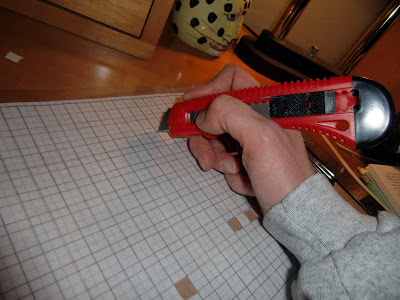
I used a box cutter to cut random squares out of the grid. I put an old wooden clipboard underneath in order to avoid damaging the desk. You could use pointy scissors for this step, but a razor-type blade makes the job much easier. (Obviously, an adult should do this step.)
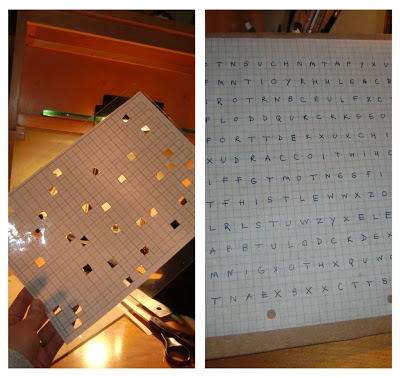
The finished template (with my “helpers” in the background):
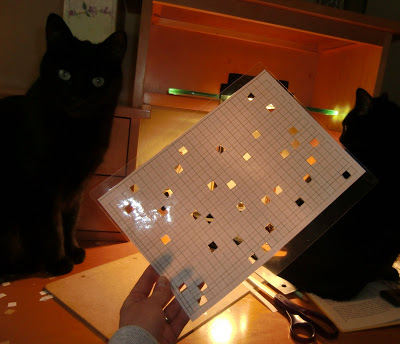
Now you are ready to encode. Place the template over a fresh sheet of paper. Mark around the corners with a pen to make it easier for the decoding person to line it up. Write your message (one letter goes in each square).

Remove the template and fill in all the open squares with random letters. Can you figure out what this says?
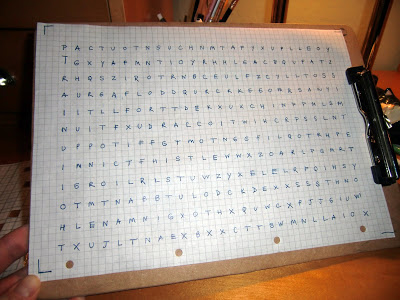
Here is the solution:
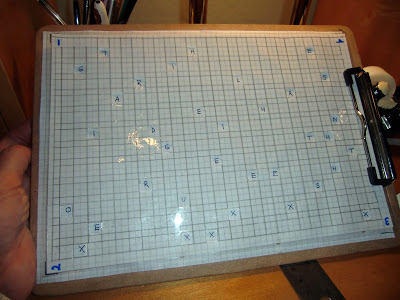
(“The girls are hiding the treehouse.” - OK, so it was supposed to say “The girls are hiding in the treehouse but we forgot the “in.” But coded messages are supposed to be brief, right?)

NOTES:

  • You can make your template as big or as small as you like.
  • For ease of communication between spies, you really ought to make a duplicate template so both sender and recipient have their own. Just place the first template over a new piece of paper, trace the locations of the squares, laminate, and cut out.
  • I numbered the corners of the template 1 - 8 because you could use both sides and all four orientations to create different messages, or even one long one.
  • Traditionally, the template was placed over an ordinary letter (see the example here) but it can be very challenging to come up with a natural sounding message built around the coded text. I gave it a try though and it was a fun mental exercise:
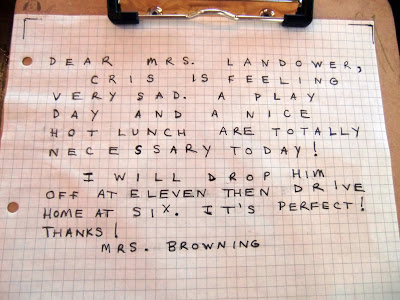
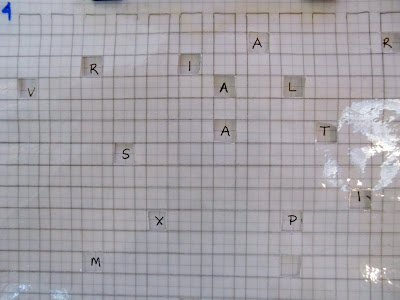
(“Arrival at six PM.”)

An Autographed Book Giveaway!

By , March 7, 2008 1:41 pm

For the last few weeks I have been talking about The Bubblegum Books TV Turn-Off Week contest: Show Your Shiny Side (open to all preschool and elementary-aged kids, whether traditionally schooled, or homeschooled - deadline is next Friday, March 14th). The contest is based on a neat book entitled Something Shiny, Something Round by Julie Goulis and illustrated by John Ferguson.

I have a fun surprise today: Brad Hauber of Bubblegum Books very kindly sent me an autographed (signed by author Julie Goulis), hardcover copy of their book Something Shiny, Something Round to give away on my blog! Thanks Brad!

The book’s rhyming text tells the story of three children playing outside on a snowy day. While they play, they come across a shiny, metal hubcap in the snow. The children imagine all sorts of different things that the hubcap might be and the colorful illustrations show their imaginings inspired by the shiny, round disc: a pirate adventure at sea, a warrior with an ancient shield, etc.

One of the most fun things about this book are the activity ideas at the end based on some of the children’s adventures. This is a very clever and useful tie-in to this story of children engaging in simple, imaginary fun.

There are two other books in the series (also by Goulis and Ferguson): The Things a String Can Be (the theme for last year’s TV Turn-Off Week contest) and the most recent, The Topsy-Turvy Towel. Let’s hope that Bubblegum Books continues this very worthy series.

I am so happy to be able to give away a book that really illustrates and encourages imaginary play. This seems to fit in so well with my recent posts about the newly discovered benefits of simple, creative play (Imaginative Play and Cognitive Function and Creative Play Makes for Kids in Control), as well as the Shiny Side contest.

So, if you are interested in winning this autographed book, please leave a comment. I will close comments next Friday night and will randomly draw a winner who will be announced here on Saturday, March 15th.

Even better, is that you have TWO chances to win. Head over to Wildwood Cottage where Jenny is also giving away a signed copy of Something Shiny, Something Round. She too, will announce her winner on Saturday, March 15th.
Good luck!

Fairies and Philosophy

By , March 3, 2008 9:47 pm

On Saturday my 7 year-old daughter had her always homeschooled 9 year-old friend over. I went about my business listening with amusement to the chatter and negotiations involved in a complicated game of “fairies,” complete with multiple changes of fairy outfits.

In the context of the recent NPR reports about the disappearance (and importance of) good old-fashioned imaginative play, the afternoon of overhearing the girls play fairies resonated with me even more than usual. In case you missed it, I wrote about both these reports recently (Imaginative Play and Cognitive Function and “Creative Play Makes for Kids in Control”).

Side note: I wonder how many 7 and 9 year-old girls play fairies any more?

I have spent a lot of time in the past week reflecting on my “parenting-style,” such as it is. Here are a few highlights:

1) Obviously I believe that too many electronic toys, games, video games and TV can be harmful. You only have to look at the title of my blog to figure that one out!

2) I have also never felt that I needed to be my children’s activity-director (like Julie on The Love Boat, to bring a TV-related image into this). See: How to get by Without the Electronic Babysitting Box. My mother didn’t spend all day entertaining me, although I certainly would have liked it if she did. There is a very common belief out there that if your children are TV-free, more input and direction are required of the parents. Many feel that a TV-free life means getting fewer things done for yourself, and a commitment to spending lots of time with your child. I have to say that I respectfully disagree with this school of thought. Which leads to…

3) I think there is nothing wrong with children being bored. In fact I believe that out of boredom comes creative play. See: Let Your Kids be Bored.

4) I feel that children today are overscheduled. I can already see that overscheduling is an easy trap to fall into, especially as children get older. I am precariously attempting to maintain a delicate balance between an activity or two, and lots of free time “to be bored.” I feel a bit like a tightrope walker… See: The Six Year-Old and Her Executive Secretary.

True Confession Time:

I absolutely adore my children with all my heart and I love spending (some) time with them. I enjoy the Unplugged Project because we can all sit down together once a week and have some fun. Yet I don’t want to be communing with my kids all day long. I wish I did, but I don’t. I have interests and goals too, and I don’t want to ignore that part of myself just because I am a TV-free, stay-at-home mom.

I am in complete awe and admiration of all those moms (and dads) out there who homeschool. (I expressed my feelings about the first day of school here: The Rapture). I would certainly attempt homeschooling if I was unhappy with the current school situation (a small Montessori school that has been wonderful for us), but honestly I think homeschooling would be hard for me. Have any of you homeschooling parents felt such things, and if so, how did you overcome it?

My friend Wishy and I talk about this subject often. We have come to the conclusion that we must be missing some sort of “mothering gene.” We worry about being Bad Moms, or at the very least, Slacker Moms.

Wishy is a big believer in “Love and Logic” parenting and she has kindly passed along a few of the podcasts. “Love and Logic” calls for a consistent approach to parenting (with which I completely agree, although consistency can be hard to carry out successfully sometimes). In fact in one of the podcasts, they go as far as to say (kind of jokingly, yet kind of not) that it is even OK to be a substandard parent, as long as you are consistently substandard. “Consistently substandard.” I like that!

And now that there has been this recent public revelation of the value of leaving kids alone to just play in creative and imaginary ways without adult involvement, I am beginning to feel like my Consistently Substandard Slacker parenting style might not be so bad after all. (I call it: CSS Parenting).

Blog Widget by LinkWithin

Fight World Hunger

Panorama Theme by Themocracy