Category: educational

Hot - Edible Sugar Science (Weekly Unplugged Project)

comments Comments Off
By , August 11, 2008 7:19 pm

Finally, here is my hot post that disappeared into the ether last night. Thanks so much to Julie K in Taiwan, Angi and Nature Mama for having the brilliant idea of emailing me the post from their Google Readers. That saved me at least an hour of rewriting! I was so down on computers this morning, but this evening I am uplifted by the fact that three people I have never met in “real life” can help me out! Thank you!!! Now, on to the post:

++++++++++++

The theme for this week’s Unplugged Project was hot. Finally, we managed to get back on schedule and do it, although we broke away from our usual craft project and went in a more scientific direction.

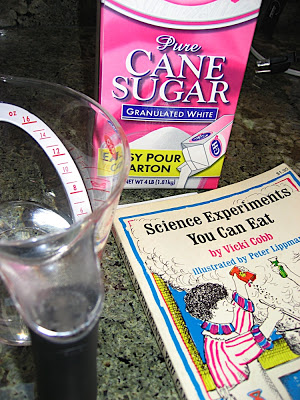
While away this summer, I found a number of good books in my Dad’s favorite thrift store (he’s a packrat too). One is called Science Experiments You Can Eat by Vicki Cobb (more about the book at the end of this post). While we were trying to come up with hot ideas, my 7 year-old daughter picked up this book and wanted to choose a food-related project. We decided on Caramel Syrup: Sugar Decomposes from the Kitchen Chemistry chapter.

Older children will find this scientifically interesting and fun to do. Younger kids will enjoy the end result!

The goal of the experiment is to teach about chemical compounds and how they can sometimes be broken down into completely different substances. Although I always liked science in school, I am not a chemist so forgive me if I am not 100% perfect in my description.

Since I am a terminal nerd, I didn’t trust the book’s very simple explanation, and actually researched sugar and how it decomposes. I learned that sugar and its breakdown process is rather complicated. (If the mysteries of caramelization keep you awake at night, then read this.)

I tried to keep it 7 year-old simple and explained to my daughter that sugar is actually carbon and water fused together. When you heat sugar, it breaks down into its original carbon and water elements. I showed her the scientific formula for table sugar (sucrose): C12H22O11 . She already new that H2O was water and could see that in the formula. After I explained that C meant carbon, she saw the carbon and water in the formula.

Heating the sugar would cause it to become watery (the release of the water) and dark (the carbon). It would no longer really be sugar.

What we needed - sugar, water, a heavy frying pan:
First my daughter poured half a cup of sugar into the frying pan:
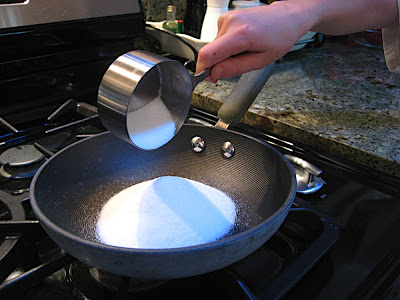
We heated the sugar over medium-high heat and my daughter stirred it:
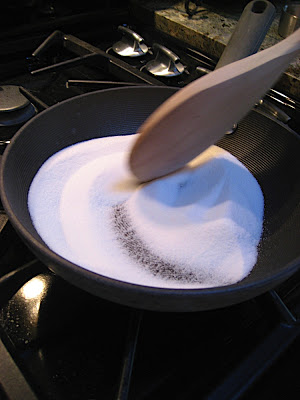
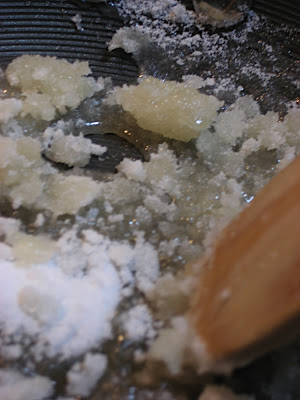
After about 5 to 10 minutes, the sugar started to melt:
As my daughter continued stirring, the sugar melted further and began to darken and become very watery:
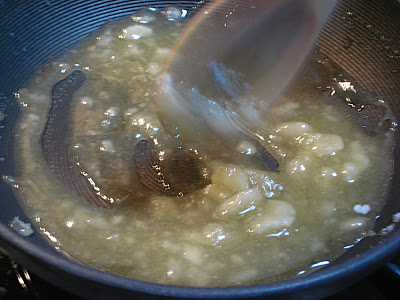
Finally it turned “straw-colored” and we had transformed our sugar into a new substance - caramel. We turned off the heat and slowly added half a cup of water in order to create a runny, edible solution. I did the pouring as the caramel was so hot that it steamed and spattered:
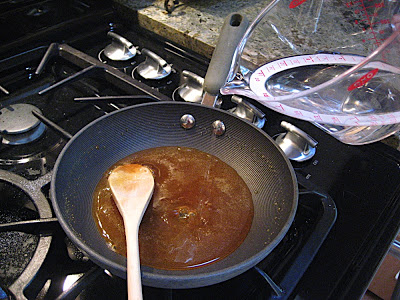
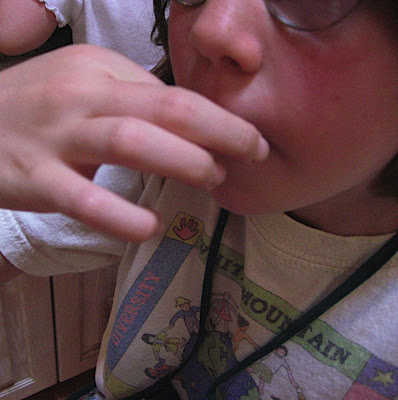
The shock-cooled caramel formed a brittle sort of candy-lump that we just had to taste:
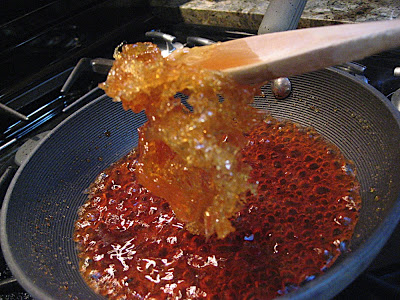
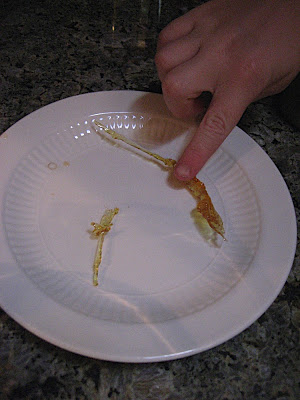
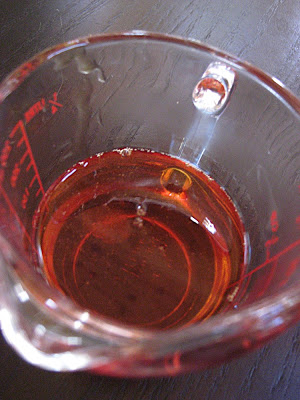
My daughter continued stirring the mixture on low heat for about another ten minutes - until the big caramel chunk dissolved into a solution:
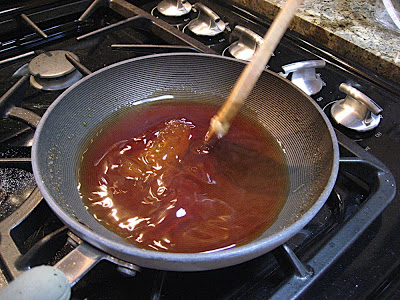
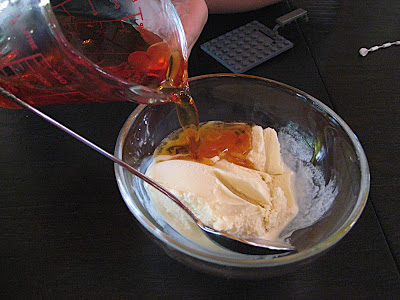
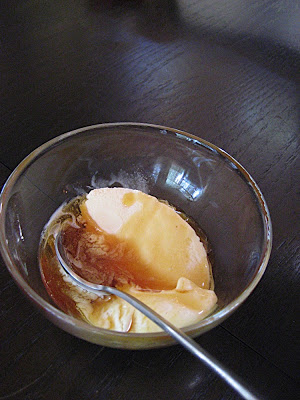
This is what we ended up with: a delicious carbon-water mixture that we ate over ice cream!
++++++++++++

If you haven’t heard of Science Experiments You Can Eat and you have scientifically-inclined children (or you homeschool), you might want to check it out of the library. Ours is an old version (1972), but the new one is supposedly revised and updated. I haven’t seen the new one, but our book has the following chapters about the science of food: A Kitchen Laboratory; Solutions; Suspensions, Colloids, and Emulsions; Carbohydrates and Fats; Proteins; Kitchen Chemistry; Plants We Eat; Microbes; and Enzymes.

+++++++++++++

If you did this week’s hot Unplugged Project, please put your link in Mr. Linky below so we can all find you. If you didn’t, please read how to join in, and consider doing next week’s project.

+++++++++++++

Next week’s Unplugged Project theme will be:

Trees

Have fun!

Review: “A Kid’s Guide to Giving” (Freddi Zeiler)

By , May 27, 2008 9:44 pm

Those of you who have been visiting Unplug Your Kids for a while, might remember my children’s Heifer International fund raising efforts. They made and sold Christmas ornaments, and earned money from their “Candy Bank” to contribute to my oldest daughter, E’s, class charity fundraising project.

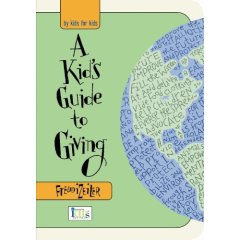
E got so wrapped up in the fun of helping others, that she announced that for Christmas she wanted a book about different charities and what they do. “Santa” brought her A Kids Guide to Giving by Freddi Zeiler.

I promised you a review if we liked it, so here it is - finally!

Ms. Zeiler (age 20 at the time of publication) really began work on this book at age 14 when she became interested in charities, and started researching and compiling notes on different charitable organizations and how they spend their money. Her parents encouraged her to expand her research and turn it into a book to inspire other young people.

This book was just what E was hoping for. The first half discusses why to give, how to choose a cause, types of contributions (money, things, and time/effort), fund-raising ideas, and more. There are also sections on why it is important to know how a charity spends its money and how to avoid scams.

The last portion is a guide to tons of kid-friendly charities arranged by subject (“People,” “Animals,” and “The Environment”). It explains what each charity does and gives contact information, website, breakdown of how each dollar donated is spent, etc.

There is a small section for notes at the end, although my daughter likes to just put a check mark by her preferred charities. The hard cover and fold-over magnetic flap make it appealing in almost a diary, or notebook-like way.

My daughter likes to sit and read it, and I am happy to let her do so. Since this is a guide for children, the charities are comprehensible to children. You will not find yourself having to explain to your 7 year-old what a rape crisis center is, for example.

My children’s “charity of the day” is the African Wildlife Foundation (discovered through this book). They have already “adopted” one animal, a leopard, and are working on raising money to adopt another.

A final note: The recommended age range for the A Kids Guide to Giving, is 12 and up. My daughter is only 7, but she is an excellent reader. In my opinion, this book is suitable for children younger than age 12 provided they have the necessary interest and reading skills.

GREAT REALTED LINK: Topaz Took was kind enough to offer a link (in her comment on my Heifer-results post) to a wonderful website called Doing Good Together, about volunteering together as a family. There is a wealth of information including how to get your family involved in helping others, as well as an interesting resources section (books, videos, and websites arranged by topic and age). Thank you Topaz!

Happy Earth Day! (April 22nd)

By , April 21, 2008 8:32 pm

I am not supposed to be online much this week since it is Turnoff Week and I am the creator/host of the 2nd Annual TV-Turnoff Week Blog Challenge (must set a good example you know!), so I will simply give you a few quick “free association” links to some worthy children’s books that come to mind when I think of Earth Day:

And here is an inspirational one by Rachel Carson for adults, that I just love:

If you want, you can read my full post about this book here.

Also: For more on kids and the environment, please see my post on Raising Environmentally Aware Children.

Happy Earth Day to all, and to all a good night!

Happy International Children’s Book Day! (Book Recommendations)

By , April 2, 2008 2:29 pm

April 2nd is International Children’s Book Day, a worldwide celebration aimed at inspiring a love of reading and calling attention to children’s books. This annual celebration was created by the International Board on Books for Young People (IBBY) a non-profit whose very worthwhile mission is the following:

- to promote international understanding through children’s books

- to give children everywhere the opportunity to have access to books with high literary and artistic standards

- to encourage the publication and distribution of quality children’s books, especially in developing countries

- to provide support and training for those involved with children and children’s literature

- to stimulate research and scholarly works in the field of children’s literature

Each year a different international chapter of IBBY hosts International Children’s Book Day. This year’s host country is Thailand.

+++++++++++++++++++++++++++++++++++++++++++

In honor of International Children’s Book Day, I thought it might be fun to write a post about 7 children’s books that we have enjoyed - one for each continent of the world! I tried to pick a book that was from, or takes place in, each continent. So here goes:

North America:

How the Stars Fell into the Sky by Jerrie Oughton and Lisa Desimini

This beautifully illustrated Navajo legend of how the stars came to be placed in the sky, has an underlying deeper meaning. How did the world come to be the chaotic and adversarial place that it is today? Blame it all on coyote!

South America:

The Great Kapok Tree: A Tale of the Amazon Rain Forest by Lynne Cherry

Marvelous illustrations tell the tale of rain forest inhabitants who each try to tell a woodcutter why he should not chop down their Kapok tree. Teaches about rain forest animals and their needs, as well as the interconnectedness of all living creatures. By the way, the ending is happy and shows the man dropping his ax and leaving the forest.

Africa:

Bringing the Rain to Kapiti Plainby Verna Aardema

An African folk tale about how Ki-Pat succeeded in bringing rain to drought-stricken Kapiti Plain. Told in a “House That Jack Built”-style rhyme that is fun to read.

Europe:

Bonny’s Big Day by James Herriot, illustrated by Ruth Brown

I decided to change the tone a bit with this selection. Until I found this charming book at a thrift store, I did not realize that James Herriot writes stories for children. Having always enjoyed his country vet series of books for adults, I was eager to read this sweet tale to my children. This story of a gruff old man and his love for his horses seems to be another of Mr. Herriot’s true tales of his days as a vet in the Yorkshire Dales. Too wordy for very young children, but animal-loving older kids will definitely enjoy this series.

Asia:

Monsoon by Uma Krishnaswami, illustrated by Jamel Akib

The poetic tale of an Indian girl anxiously awaiting the arrival of the annual monsoon rains. Beautiful written imagery combined with wonderful pastel illustrations vividly depict life in an Indian city.

Australia:

Big Rain Coming by Katrina Germein, illustrated by Bronwyn Bancroft

(I guess I have a real rain theme going here!) Unfortunately, I must admit that we seem to have no story books from or about Australia in our home collection. Factual books about Australia? Yes. But stories? No. I am totally embarrassed, especially if any of you reading this are Australians. I did however, find this book online and it seems like a really good one. The story is yet another about waiting for rain! The intricate, aboriginal style illustrations are what really seem to make the book. According to the School Library Journal review on Amazon: “The text is well paced with a perfect rhythm for reading aloud, and the large, clean double-page spreads make for easy viewing.”

Antarctica:

Antarctic Antics: A Book of Penguin Poems by Judy Sierra, illustrated by Jose Aruego and Ariane Dewey

Ha! I bet you didn’t think I could come up with one for Antarctica, did you! Actually, Antarctica should have been my most difficult, not Australia. But fortunately I had this book in the back of my mind all along. We just love this little book of funny and educational penguin poems. Each poem teaches something about penguins in a very humorous way. I really can’t recommend this one enough! (For more information, read my review here.)

Happy International Children’s Book Day to all, no matter what continent you call home!

+++++++++++++++++++++++++++++++

More links of interest:

+ My post about last year’s International Children’s Book Day which has lots of links to websites and stores for finding multicultural and international children’s books.

+ My post about ways to foster international understanding and interest in your children.

Rocks (Weekly Unplugged Project) - Petroglyphs

By , March 30, 2008 7:29 pm

It has been a week full of rocks during Spring Break at our house in Albuquerque: a trip to Petroglyph National Monument, climbing over big rocks on a mountain hike, choosing pretty tumbled rocks to buy at the Natural History Museum gift shop, collecting rocks in the courtyard.

So, although I didn’t realize that we would be so into rocks this week when I chose the Unplugged Project theme last Sunday, it has been an excellent week for a rock project.

My son was too busy with his new Legos this week to care much about projects, but my oldest daughter wanted to make her own petroglyph. The children have both recently studied petroglyphs at school and I think that Petroglyph National Monument made a big impression on them.

We found what we thought would be a suitable flat rock (note: if you try this, make sure you choose as soft a rock as possible), and used a hammer to break a piece of it off to use as a chisel. We were trying to be authentic!

My daughter drew her design on the rock with a pencil. She was trying to reproduce one that we had seen at the Monument.

She then scraped the rock with the other rock to engrave the design.

Well, this proved to be slow going (the rock was not soft enough), so she got fed up and moved on to authentic Native American method number two: the Dremel Tool! My husband supervised this step and the petroglyph was quickly completed.

In case anyone is interested, here’s another fun rock idea that we once did: cracking open a geode!

Other petroglyph resources:

+ Draw your own rock art printable

+ Hawaiian petroglyphs to print and color

+ Info about petroglyphs: Petroglyphs.us

+ Fun art project: Sandpaper Petroglyphs

+++++++++++++++++++++++++++++++++++++++

If you joined us for the Unplugged Project this week, please leave a link in Mr. Linky, as well as a comment in case Mr. Linky fails at his job. If you didn’t join in, please consider taking part next week!

+++++++++++++++++++++++++++++++++++++++

Next week’s Unplugged Project theme will be:

Books

Hope to see you then!

Blog Widget by LinkWithin

Fight World Hunger

Panorama Theme by Themocracy