Category: Book Recommendations

Easy Homemade Musical Instruments

By , January 14, 2009 10:25 am

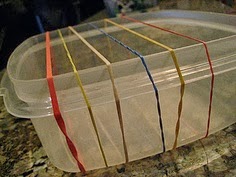
Thanks to a wonderfully creative music teacher at my children’s Montessori school, the latest fad around our house are little homemade guitars/harps like that shown above. The kids are loving putting different sized rubber bands around my food storage containers and then experimenting with the sounds produced.
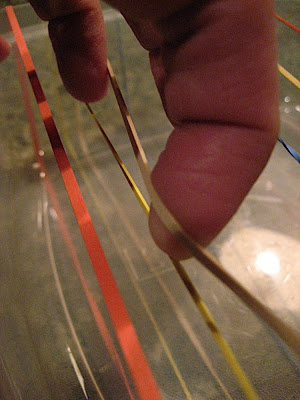
The sound reminds me of a kalimba. It’s a little hard on me when I need to put away some food and can’t find any containers, but…oh well. I can adjust.

These simple little string instruments made me think that a post about quick and easy homemade musical instruments might be fun to write. I obviously won’t be anywhere close to covering all the homemade musical options, so if you think of something I forgot, please leave your idea in the comments.

If you are here because you are looking for musical instrument ideas, then be sure to read the comments for more ideas. Unplug Your Kids readers are very creative!

Here are my ideas:

  • Let gourds or squash dry out. Once they are completely dry, the exterior will be hard and when you shake them, the seeds will rattle around inside. You’ll have some nice, natural maracas.
  • Quick maracas: Fill plastic Easter eggs with rice or lentils and tape shut. Instant shakers!
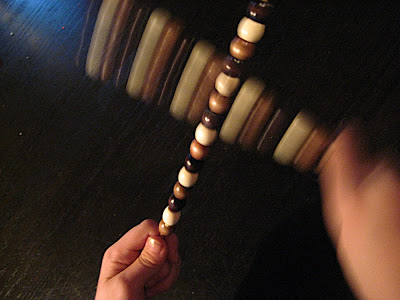
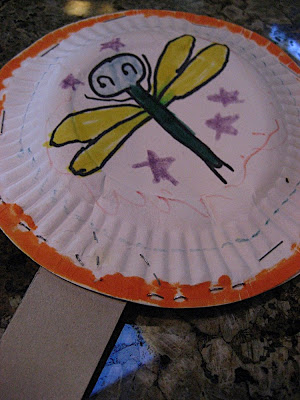
  • Paper plate maracas: Put some dried beans on a small paper plate. Cover with another, upside down paper plate. Staple the two plates together around the edges to seal them shut. Add a cardboard or popsicle stick handle if you want, then decorate. Here is ours:
  • Wrap tissue paper around a fine tooth comb and make “Doo-doo-doo” noises through it for a kazoo sound.
  • Flip over empty cylindrical cardboard oatmeal containers and bang on the bottom to make a drum.
  • Line up a row of glasses and fill each with a different amount of water. Tap them with a spoon and note the different pitches. Play a tune!
  • If you have a thin-rimmed wine glass, fill it with water. Wet your finger and rub it slowly and gently around the rim to create your own glass harmonica. It might take a bit of experimenting to figure out exactly what pressure you need, but the results are impressive. Experiment with more water in the glass and less water. What happens to the pitch? What about an empty glass?
    NOTE: Benjamin Franklin invented a mechanical glass harmonica like this modern one based on his design (he called it an “armonica”):
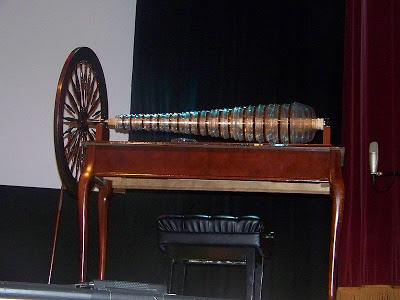
If you have never heard it, you must listen to the rather fairy-like sound of an armonica!

      Can you play a tune with several glasses with different levels of water? You might not sound

this good

    , but it’ll be fun!
    • Blow across a glass soda or beer bottle like you would play a flute. Unless you play the flute, it’ll take a bit of practice. Adjust the angle of the bottle against your lips until you get it right. It will make a lovely tone. Different levels of liquid will produce different tones. What about lining up many bottles with different levels of liquid and playing a song?

(NOTE: Great related link - Bottled Music. This link tells exactly how much water is needed in a twenty ounce bottle to produce each particular note of the scale, and even has instructions for playing Row Row Row your boat on the bottles.)

I didn’t think these sounded too much like crickets, but they do make a cool sound for your musical instrument collection! Learn how to make them here.

  • Another craft idea: Sandpaper blocks - Wrap sandpaper around two blocks and attach it to the back with thumbtacks. For easier handling you might want to attach a knob to the back of each block (with glue or screws). Rub the blocks together for a cool sound. Try coarser and finer paper for different sounds.

And of course, the obvious: turn your 2 year-old loose in your pots and pans cupboard for lots of drums, cymbals and noise music.

That’s it for what’s in my brain right now, but Googling “homemade musical instruments” produces lots of cool results.

Here are links to a few of my favorites:

Jingle Sticks

Rainstick

Didgeridoo

Inventing Homemade Instruments with Math and Measurement (a wonderful website that teaches the science of music!)

Artists Helping Children (a very long list of many musical instrument craft links - useful!)

For a book that has some fun instrument games and activity ideas for young (preschool) children to use their homemade (or non-homemade) simple instruments, consider 101 Rhythm Instrument Activities: for Young Children by Abigail Flesch Connors:

NOTE: This is a great book to use with young children, older ones might find it boring.

Fluffy - Pom Poms for Peace (Weekly Unplugged Project)

By , December 7, 2008 8:35 pm

This week’s Unplugged Project theme (fluffy) was not premeditated, it just popped into my head.

I wanted an adventure this week so I thought long and hard all week about what to do. Cotton balls? Ordinary. Dryer lint? Flammable. Pom poms? What does one do with pom poms besides add some googly eyes? Not in the mood.

But then I found this: Pom Pom International!

Amy Lamé has a vision. She is trying to bring people of the world together. But how? With music? No. Art? No. What then? Pom poms!! What could be less politically charged and more fun and appealing to humans everywhere, than the humble pom pom! As Amy puts it:

Dealing with differences is much easier with a stress-busting pompom in your hand.

This is what it is all about:

Pom Pom International travels to areas of conflict around the globe. Together, we create whimsical,
non-political, creative balls of fluffy yarn in a gesture of peace and reconciliation. All pom poms are tagged, tracked and sewn together to make the biggest pom pom in the world.

Why not? I love this idea!! A peace pom pom!

If you can’t make it to a live pom pom making event, then you can create your pom pom at home and send it to Amy. Email her a photo of you and your pom pom and she’ll add it to her online gallery.

I remember my mother teaching me how to make pom poms and I have a distinct fondness for them, so I was quite excited to make pom poms for a higher purpose than merely a place to stick googly eyes.

Pom poms are surprisingly easy and fun to make. All you need is some sturdy cardboard (corrugated is best) and leftover yarn:

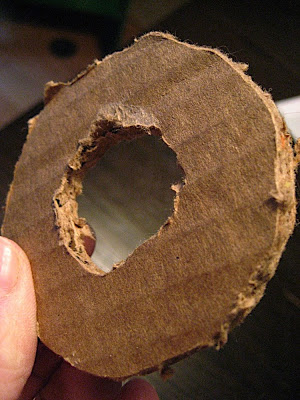
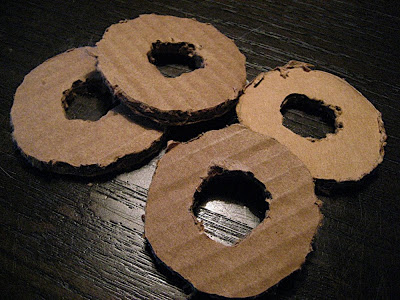
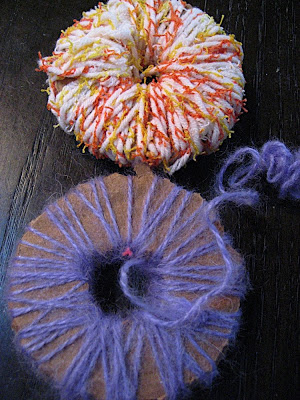
Cut two matching circles out of the cardboard. Next cut matching circles out of the middle of the original circles so you have a doughnut shape. (NOTE: Our cardboard was from an extra heavy box so I ended up using a dremel tool to cut these, but you really don’t need cardboard that is quite that tough!):

The width of the “ring” portion of your doughnut (distance between outer edge and start of inner hole) will determine the size of your pom pom (bigger band=bigger pom pom). Also, I would advise making your donuts a bit bigger than we did so that the middle hole can be bigger. A larger hole makes it easier to pass the yarn through.

Place your cardboard rings together like a sandwich.

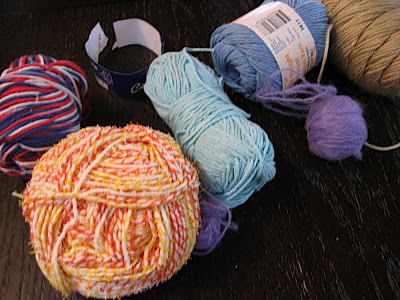
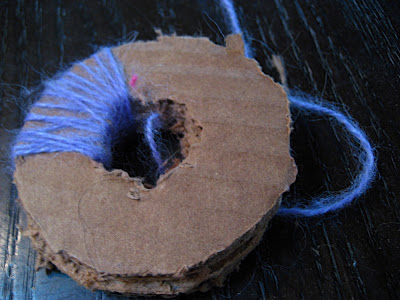
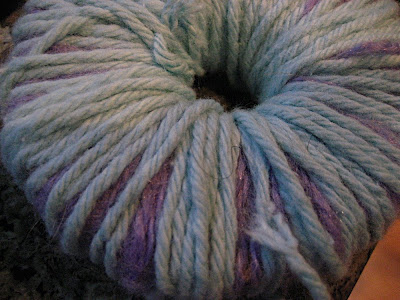
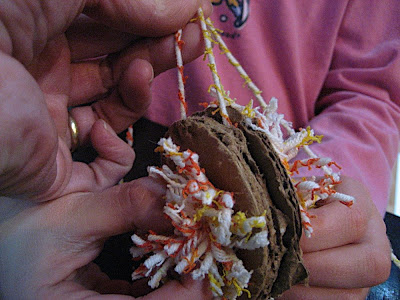
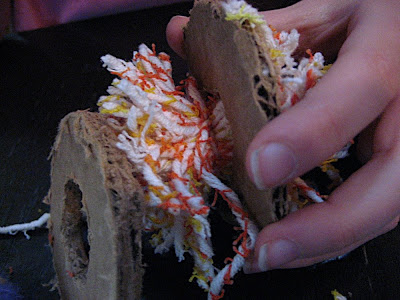
Choose your yarn and cut a length that is several yards/meters long. Roll it into a small ball so that it can easily pass through the center hole. Pass the loose end of the yarn through the hole and hold on to it with your thumb. Wrap yarn tightly around the doughnut like this (once you start wrapping, you can let go of the loose end):

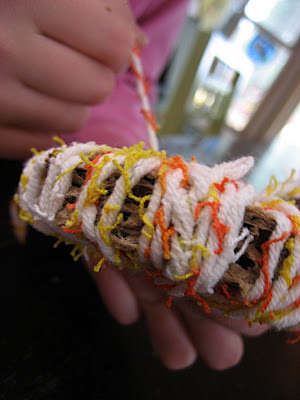
Keep wrapping all around the circle as many times as necessary to completely cover it. Keep going until you can no longer fit any yarn through the hole … or you run out of patience, whichever comes first! The more yarn you use, the thicker and puffier your pom pom will be.

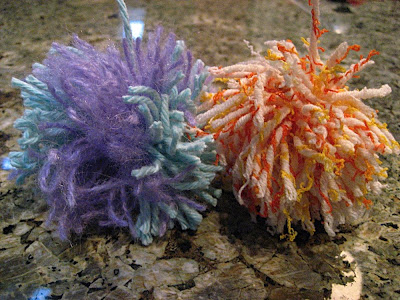
When you finish your first small ball, you can easily add on more yarn by simply threading the loose end through and holding it with your thumb, just as you did before. You can change colors this way too, as I did with my blue and purple pom pom.

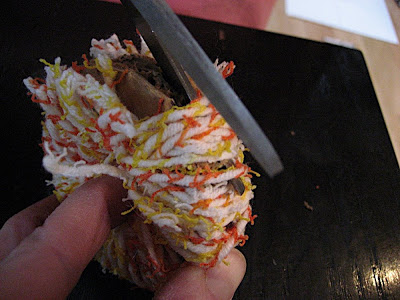
When you are through wrapping, cut the strands all the way around the edge of the doughnut with the scissor tips between the two cardboard pieces.

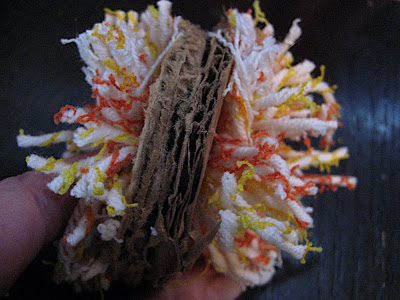
Now wrap a long strand of yarn around the pom pom, between the two sandwiched sections and tie tightly:

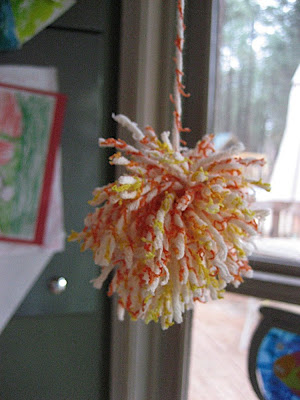
And finally, the really exciting part: gently pull apart the two cardboard rings to reveal your completed pom pom. Trim and fluff as necessary, and there you have it! A nice, fluffy, pom pom for peace!

In order to have your pom pom be a part of the giant peace pom pom simply print out a tag for each pom pom from the Pom Pom International website, take a photo of you and your creation for the website’s gallery (send it via email), then ship your tagged pom poms to Pom Pom International in London, England! Full instructions, tag and addresses are here.

Tomorrow after school we will be off to the post office to send our peace pom poms to England. The children are very excited!

++++++++

LINKS:

Amy’s explanation and diagram of making a pom pom - very helpful!

Pom Pom International

Pompoms Can Save the Planet - May 6, 2008, The Scotsman Newspaper

By the way, Amy also gratefully accepts donations of any leftover or recycled yarn balls and bits. Send all “orphaned or previously loved yarn” here:

NEW Pom Pom International HQ
106 Lower Marsh
London SE1 7AB
ENGLAND

It will be used for the free pom pom making events.

If you are feeling really enthusiastic, she also seeks Pom Pom International Ambassadors. Can you volunteer to organize a pom pom making booth at a crafts or art fair? How about a club event? The more pom poms, the better.

++++++++

Did you do a fluffy Unplugged Project this week? If so, then please post a link to your project post (not just your blog) in Mr. Linky below. If you didn’t participate but would like to learn more, then please do not link, but read about it here.

++++++++

The theme for next week’s Unplugged Project will be:

Curly

Have fun!

++++++++

Happy Holidays!!
(“…brought to you by ___”)

By , December 3, 2008 8:03 pm
This entry is part 19 of 21 in the series Unplug Your Holidays

This is a post I should have written about two months ago. Two months ago when all the cheap plastic decorations first made their way into the supermarkets, Walmarts, Kmarts and Any-Other-Marts in the United States. Here in the U.S., shoppers have been regaled with muzak versions of The Little Drummer Boy and Silent Night since well before Halloween (October 31st) this year.

Now that we have finally gotten that pesky little Thanksgiving holiday over with, the commercial Christmas onslaught can begin in earnest.

On my Thanksgiving cross-country trip, I realized what I have been missing without TV for all these years. Ads. Hundreds and thousands of ads promising me the best Christmas ever (what is that anyway?) if only I purchase a new Best Buy flat screen TV, or Macy’s cashmere sweater, or Zales diamond necklace, or _______ (insert advertised product in blank) for my loved one.

I had forgotten what it was like. Although I had a fabulous trip, I was quite relieved when I was finally home and able to retreat to the refuge of my quiet house to end the commercial attack on my psyche.

And here comes the part that I should have written about three months ago when I first detected the initial stirrings of faux holiday jolliness in the stores:

Since many readers are probably new to Unplug Your Kids, I should let you all know that last year while suffering a holiday existential crisis, I wrote a series of posts entitled Christmas/Holidays Unplugged in which I explored alternatives to the traditional American commercial holiday experience.

I know it is a bit late now that December is already here, but if anyone is in need of a bit of inspiration, or encouragement, or alternative holiday ideas, then hopefully you might enjoy some of these posts.

I have listed them all here and linked to them so you can click on what sounds interesting to you. I hope that someone will find this helpful!

(Also: If you find a topic interesting, be sure to read the comments too since readers often left their own wonderful insights and suggestions.)

1) Merry Christmas

2) Unplug The Christmas Machine (a book review - very inspirational book if you are disillusioned with Christmas/Hanukkah)

3) Making a List and Checking it Twice (what does your holiday really mean to you?)

4) Holiday Prep - Part 1 (Introduction)

5) Holiday Prep - Part 2: Help! Holiday Prep Makes Me Miserable!!

6) Holiday Prep - Part 3: Help! I Love Doing it All, But How Can I Find Time to Do it?

7) Celebrating Advent

8) Commercialism in Your Mailbox?

9) A Holiday Linky Assortment

10) The Great Christmas Tree Dilemma (Real? Fake? Living? What else?)

11) Buy Handmade

12) Donate this Year Instead of Gifts

13) Santa Lists and Sponge Bob (dealing with kids’ gift requests)

14) Combating Commercials (fighting the effects of toy ads)

15) Help! Too Much Stuff!! (ideas for cutting down on the amount of “stuff”)

16) A Post as Small as a Stocking Stuffer (“nice toy” stocking stuffer ideas)

(Thanks to Everystockphoto and phtographer”tandemracer” for this photo. View license terms here.)

1940′s Innocence - Maj Lindman’s Series (Chapter Books Suitable for Extra-Young Readers)

By , October 16, 2008 1:39 pm

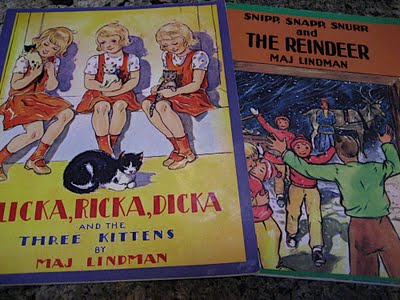
I am on a roll with Swedish children’s books after last week’s recommendation of Astrid Lindgren’s The Children of Noisy Village and Happy Times in Noisy Village. That post reminded me of Maj Lindman’s two lovely series: Flicka, Ricka, Dicka and Snipp, Snapp, Snurr.

Don’t you love it when you wander into a thrift store and discover something wonderful? I know I do. It always brightens my day when that happens. Snipp, Snapp, Snurr, and the Reindeer and Flicka, Ricka, Dicka and the Three Kittens were that kind of happy thrift store find!

The Snipp, Snap, Snurr series (first published in the U.S. in 1957) is about three adventurous little Swedish boys in, I would estimate, the 1930′s or ’40′s. Although the books seem to be written with boys in mind, my daughters love them too.

The Flicka, Ricka, Dicka books (first U.S. publication was 1941) are about (you guessed it!) three adventurous little Swedish girls of that era. Again, although targeted toward girls, my son loves these books as much as his sisters do.

The books are short, about 24 pages each. Since each two page spread includes one page of text (in very large type) and a wonderful Maj Lindman 1950′s-style illustration on the facing page, there are really only 12 pages of text per book. There are no chapters, but these are entirely suitable for beginning chapter book readers since they are so short and fairly simple:

Each book involves an innocent adventure with a little bit of minor drama (boys lost in the snow, a missing cat, etc.) that is, of course, always happily resolved. None of it is too suspenseful or frightening which makes it appropriate for even the youngest new readers.

Also, if you don’t mind buying from Amazon, they are all part of the 4-for-3 promotion so you could get four of these wonderful Maj Lindman books for the price of three!

Our first two:

The others (those that are easily available in the U.S.):

Snipp, Snapp, Snurr -

Flicka, Ricka, Dicka -

Chapter Books Suitable For Extra-Young Readers (Book Review - Part 3)

By , October 8, 2008 9:06 pm

When you have a child who is reading very well at an early age, it can sometimes be difficult to find books that are challenging enough for your young reader, yet innocent enough for a child who is not ready for more mature subject matter.

I have a few suggestions. If you have not yet read Parts 1 and 2 of this series, then please head on over for some other ideas.

This week, I want to mention another lesser known set of books that we just adore. These would appeal to boys as much as to girls.

I already reviewed the first book in the series a long time ago, so I feel a bit like I am cheating. But things get buried in a blog and I MUST mention this series again because I think it is so wonderful!

This week’s suggestion is the “Noisy Village” series, by Astrid Lindgren (most commonly recognized as the author of the well-known Pippi Longstocking series).

I desperately wish there were more, but the series consists of only two chapter books: The Children of Noisy Village and Happy Times in Noisy Village.

There are also two short picture books (32 pages): Christmas in Noisy Village, and Springtime in Noisy Village (which is harder to come by).

The very charming Children of Noisy Village is actually one of the first chapter books I ever read out loud to my two oldest children. We sat on the sofa in front of the fire on a boring, snowy Sunday and all three of us laughed out loud at the funny adventures of the Noisy Village children. Much to my delight, I even found a bit of more subtle humor in the book that escaped my children. These moments kept me wanting to turn the pages as much as my children did.

In case you missed my first review, the three Swedish farm houses that comprise “Noisy Village” are inhabited by a pack of mischievous children ages 9 to 11 (as well as a baby or two). The tale is very convincingly narrated in the first person by 9 year-old Lisa.

The era of the book is never specified, but according to the “About the Author” section, Astrid Lindgren’s writing was greatly influenced by her childhood on a small Swedish farm. Since she was born in 1931, that would probably place the setting of this book sometime around 1940.

None of these simple adventures are mean or malicious, but are completely innocent and charming. I was also struck by the fact that the children never talk back, or act in a disrespectful manner to each other or their parents, as I find to be the case with many books of this genre nowadays.

If you read these books out loud, make sure you have plenty of time since you might be begged to read them cover to cover in one sitting.

For silent-reading I would place them on the same level of complexity as the Fairchild Family books by Rebecca Caudill that I reviewed last time. That is, not suitable for beginners, but perhaps not quite as advanced as the The Little House series.

More details to help you determine the suitability for your child: each of the two chapter books is about 120 pages long and is divided into 14 chapters. Typeface is medium and there are quite a few sweet line drawing illustrations (by Ilon Wikland) scattered throughout the book.

The only picture book I have seen is the Christmas one. I don’t like it as much as the chapter books. There are more illustrations, and they are in bright colors. Somehow, I prefer the subdued black and white line drawings of the originals.

Also, although the story is fun in the short Christmas book, there is a scene where one of the older boys pretends to be Santa and brings in the gifts. In my mind, this brought up the whole “is Santa real” question. Fortunately however, it seemed to escape my children and we didn’t have to address that issue. The Christmas chapter in The Children of Noisy Village was different and didn’t venture into such perilous territory.

Conclusion: I can’t recommend these chapter books enough, for both girls and boys!

Blog Widget by LinkWithin

Panorama Theme by Themocracy