Category: peace

Heifer Project Successful! Thank You!

By , March 15, 2008 5:19 pm

A Heifer International fund raising update:

My daughter’s Montessori class ( 1st-3rd grade) of 20 children raised a total of $1,067 to donate to Heifer International! Each child raised money their own way.

Last semester the class studied basic human needs, and this semester they are studying the continent of Africa. This fund raising project ties in with both those themes.

My daughter (and 5 year-old son) made and sold Christmas ornaments by the side of the road and contributed candy and junky “toys” to their Candy Bank to earn money for the project. In addition to each child’s individual earnings, the class also held a bake sale in the school parking lot (on a very snowy day!!).

I just wanted to post an update about this project since someone out there who knew my address, was so kind as to spread the word and organize contributions from all over the country. Truly amazing! Thank you again whoever you are!

The class earned nearly double their original goal and instead of buying an animal or two for one family, they are able to fund a project that will help an entire African village.

Your generosity, and that of our local community, makes a HUGE difference. Not only to a village in Africa, but to my daughter and her classmates who now know how good it feels to give and to help others. Thank you!

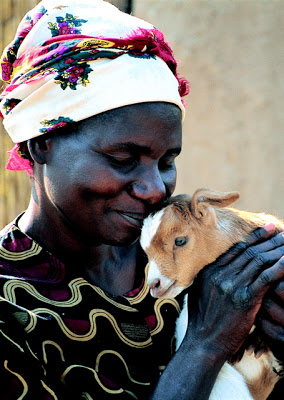
Photo (Zambia) courtesy of Heifer International.

Dona Nobis Pacem (10 Ideas for Fostering International Understanding in Your Kids)

By , November 7, 2007 12:59 am

Sometimes I am a glass half-full type of person, and sometimes I am more inclined to be a glass-half empty type.

About peace…I think I am running on empty. I feel that throughout history there never has been peace. There never will be peace in the future either. It is just human nature to fight.

Religion, which is supposed to be all about peace (no matter what the religion), seems often to make matters worse. The Crusades, the Inquisition, etc. I’ll stop my brief list there so as to not get myself into too much trouble.

The glass half-full part of me says: “Hey, wait a minute! Why not start with the children?”

Well, why not start with the children? What an excellent idea. If all the world’s children could learn about and appreciate other cultures, races, and religions, then wouldn’t there HAVE to be peace?

Glass half-empty says: “There is no way to teach every child in the world these things!”

Glass half-full says: “Maybe not, but the way to start is with our own children. Let’s teach them about the beauty of diversity.”

Yes let’s.

+++++++++++++++++++++++++++++++++++++++++++++++++++

Here are ten thoughts on how to do that:


1) Have your child learn a foreign language, either through their school or through home, online or language school study. The US is one of the only countries in the world where a child/adult can get all the way through school, and even college and beyond, without learning another language.

2) Take your children to local multicultural events such as Chinese New Year celebrations, Greek festivals, etc. Check your local paper for details.

3) Travel with your children, which leads to the next suggestion:

4) Get your child a passport now so that he or she can travel with you when old enough, and the opportunity for foreign travel arises. Passport processing is taking a long time these days, so why not simply put it on your to-do list and get it over with right away. (Most US post offices can issue passports and even take the passport photos, it is very easy). By the way, passports are now required for air travel to Canada, Mexico, the Caribbean and Bermuda, even for infants.

5) If your children are teens and are interested…let them be an exchange student. I did it as a teen (twice) and it totally changed my life!

Youth for Understanding (the program I used)

AFS Intercultural Programs

ASSE

6) Host an exchange student in your home (it doesn’t have to be for a year, it can be a semester, a summer, or even less!) Check out links above, or Google “international student exchange.”

7) Get your child a penpal. Google “penpal” for some sites that can arrange this. Being the paranoid parent, I would check it out carefully first though before signing up. I would choose a “snail mail” penpal over an email one, and would monitor the whole thing very carefully. Check with your child’s school too. Often penpal arrangements can be made through a teacher at school. If a teacher has contact with a teacher in a foreign country, many times classes can exchange letters.

8) Go to the library and check out an international cookbook. Cook an exotic foreign meal together, talk a little about that country, and find it on the map or globe.

9) If you and your family are really in the mood for adventure, either rent a house in a foreign country or do a house swap. A house swap is where you trade a month in your house, for a month in someone else’s house for example. Sometimes the trade even includes the use of a car. There are many websites dedicated to rentals and home swaps. The classifieds in the back of alumni magazines are also a good source. Many college alums prefer to rent their foreign house or apartment to another responsible alum rather than a total stranger.

Here are some house swap websites (note: I am not personally familiar with any of these):

HomeLink International

Home Exchange

Home Xchange Vacation

10) And of course the simplest and cheapest way to expose your children to other cultures, is to read to them. Go to the library. Read multicultural books to your children. Check my International Children’s Book Day post for detailed suggestions of books and web links to books for some ideas.

For inspiration, here are some of our favorite multicultural/international books. The last one is a real eye-opener: Material World: A Global Family Portrait, is geared more toward adults, but children will find it fascinating too, when read with an adult.

(For more info on two of these titles: I have written posts about Wake Up World, and Let’s Eat - plus another here about Let’s Eat)

Dona Nobis Pacem…Grant Us Peace - PLEASE!!!

Please visit Mimi’s Blog to find links to many, many, many more Peace Posts today.

Also, for more thoughts on peace, please visit my June Dona Nobis Pacem post.

3 Environmental Thoughts: Blog Action Day - October 15

By , October 13, 2007 8:16 am

THOUGHT #1:
For a few weeks now I have had this little picture in my sidebar. It is a link to www.blogactionday.org. Blog Action Day is scheduled for October 15th…as in this coming Monday…as in the day after tomorrow.

The idea behind Blog Action Day is to get as many people talking about the environment, as possible. As of this morning, the Blog Action Day website has 12,316 blogs signed up to participate. These blogs are estimated to reach a worldwide audience of 11,284,000 readers!! Wow!

All you have to do, is write a post on Monday that is somehow related to the environment. It doesn’t have to be fancy. It can be anything at all really: funny, informative, serious…how about a book review? Or even a photo? The idea is to write in order to join a global conversation on October 15th.

If you decide to do it, you can register your blog here. The Blog Action people will post a link to your blog as a participant and add you to the other 12,316 involved blogs!

THOUGHT #2:
In order to get you all thinking about the environment, I found (via the Blog Action Day Resources page) an interesting little test to take which will calculate your personal or household environmental impact and compare it to the US average. Mine was scary. How’s yours? The test is at the Nature Conservancy website.

THOUGHT #3:
Congratulations to Al Gore and the UN Panel on Climate Change for winning the Nobel Peace Prize. If you haven’t heard yet, Al Gore and the UN Panel were jointly awarded the prize yesterday for their efforts to spread awareness of the effects of human-caused climate change and to come up with steps to counteract it.

The Nobel Committee announcement stated that Mr. Gore “is probably the single individual who has done most to create greater worldwide understanding of the measures that need to be adopted.” You can read the entire announcement here.

To quote another Nobel Peace Prize recipient (1964):

“Let us realize the arc of the moral universe is long, but it bends toward justice.”
- Martin Luther King Jr. (
“Where Do We Go From Here?” speech, 1967)

What Goes Around, Comes Around…

By , October 3, 2007 11:00 pm

Thank you all so much for the comments on Monday’s post (The Great Candy Dilemma). Your interest truly warmed my heart and I was so pleased to see a few new commenters. Thank you!

It is funny how something so small as a comment from a reader can really make a blogger’s day, and I am sure all bloggers would agree. In cyberspace, a comment can be like a handshake, a pat on the back, even a hug. It makes me happy to know that I have reached someone and they have reached back.

Before I get all mushy and sentimental here, I’d better get to my point. A comment makes me happy. When I am happy, I make my kids happy. They then make their teachers and class mates happy, etc. etc. etc. Pay it forward. Good karma. What goes around, comes around. Whatever you call it, it is a fact of life, and one that I would like my children to learn.

My pleasure from all your virtual hugs and handshakes reminded me of a few books that we have that help kids understand the whole “pay it forward” idea.

Love and Kisses (Author: Sarah Wilson, Illustrator: Melissa Sweet):

First is a book for little ones called Love and Kisses. I read this to the baby tonight, it is one of her favorites although she is probably too young to “get” the deeper meaning. I bought it in board book format when my now seven year-old was a baby, and it has held up really well even after being loved by three children.

The story begins with a little girl blowing a kiss to her cat, “Blow a kiss and let it go. You never know how love will grow!” On the next page, we see the little girl kissing her cat again. On the following page the cat kisses a cow, who kisses a “giggling goose,” who kisses a fish, etc. etc. You get the idea. The kiss passes through a variety of very sweetly illustrated animals and ultimately ends up where?? Yes of course! Back to the cat, then to the girl. The last two pages say: “Kisses! Kisses! Smooch and smack! You’ll have your love and kisses back!”

This is such a happy little book. Even though the message is profound, it still makes for a happy, uplifting bedtime read that toddlers can enjoy. The text is a melodic rhyme and the illustrations are really cute and funny.

The book comes new in a board book or paperback format (both are eligible for Amazon’s 4-for-3 promotion), or you can find used hardcovers. I personally recommend the board book version since mine has lasted forever, and toddlers really like this book!


Because Brian Hugged His Mother (Author: David L. Rice, Illustrator: K. Dyble Thompson):

This book tells the story of little boy Brian who woke up one day and decided to run into the kitchen and give his Mom a big hug and kiss, and tell her he loved her. Of course, “Brian’s mother felt loved and appreciated” and made Brain and his sister Joanna their favorite breakfast. So, at school, Joanna helps her teacher, who then does something nice for the new principal, who was so happy, that she was lenient with a misbehaving student and so on, and so on.

Of course, after passing through many different people in Brian’s town, the kindness eventually ends up with a police officer who catches Brian’s Dad speeding, but because she is feeling “supported and honored,” she gives him a warning instead of a ticket. Brian’s Dad, feeling “grateful and relieved” reads an extra long time with Brain before bed. That made Brain feel “loved and treasured” so he had pleasant dreams, slept well, and awoke feeling great. He then ran to the kitchen to give his mother a hug!!

As you can glean from my summary, not only does the book teach the concept of karma very simply and plainly, but it is also provides a wonderful opportunity to discuss feelings. Each character feels differently (in a positive way) after being the recipient of a thoughtful deed. A discussion of words like “valued,” “accepted,” “respected,” or “honored” can really enhance a child’s understanding of the many nuances of positive emotions.

The illustrations consist of quite life-like watercolors that nicely depict the scenes of daily life that accompany the text.

Because Brian Hugged His Mother is available new in a paperback (another 4-for-3 book at Amazon!), or used as a hardcover.

Karma Cards - Kids Set

OK, I promised books, but this is not a book. It is a set of cards. “Santa” left these cool cards in my oldest daughter’s stocking last Christmas. For a long time we were doing one of these every morning and a Sweet Dreams Card every night before bed. While the Sweet Dreams Cards are still a “must” before bed, the Karma Cards have fallen a bit by the wayside lately, perhaps due to our hectic morning schedule (ie. Mom isn’t a Morning Person). Well, we rediscovered them during a room cleaning and my daughter is “into them” again!

I am not a baby flashcard sort of mom, but for the right child, these cards seem to be a fun way to teach the pleasures of positive actions. Since my daughter is so hooked on the Sweet Dreams Cards, these work for her.

The idea is that a child chooses one of the 25 cards and does what the card says at some point during the day. Some examples are: “Choose one of your toys to donate to a charity,” and: “Find a penny dated the year of your birth and give it away to someone special.” Most of the cards spread kindness to others, or help you feel better about yourself. Several are merely useful in a more practical sense, such as practicing a family fire drill, or learning the words to your national anthem.

In case you feel like you could use a little karmic nudge yourself, there are also Karma Cards for adults with a variety of themes (including Karma Cards for the Environment - that is my personal area of deficiency and guilt). I have not looked at any of these adult sets, but stop by the Karma Coaching Cards website to see what else they offer. These cards are recommended for children ages 5 and up - with adult supervision.

Stoves (and Setting an Example)

By , July 30, 2007 7:16 pm

I recently wrote a post about a child who decided to take it upon herself to solve a problem and make a difference in the world. See my post: Involved Kids . In this post, I mention how much easier it seems for children and young people to take action when they sense a need. Adults are often too caught up in the complexities of life to bother.

It was with thoughts of this recently written post fresh in my mind, that I came upon this article in Newsweek magazine: The Flames of Hope (Newsweek, July 16, 2007) about a Berkeley physicist who has invented a stove to be used in Darfur that burns 75% less firewood. This seems unremarkable, but when you consider the unimaginable price women pay to leave their camp to simply collect cookstove firewood in Darfur (rape, mutilation, 7 hours of travel - men can’t go for they would simply be killed), it is a huge asset.

Apparently physicist Ashok Gadgil received a call in 2004 from the U.S. Agency for International Development asking if he could design a press for turning the Darfurians trash into fuel pellets. Gadgil determined that this was not a feasible plan, but rather than give up and carry on with his affairs, he continued to consider the fuel problem. He eventually realized that instead of redesigning the fuel, he could re-engineer the stove. So he did.

The result is an efficient stove that produces the high heat necessary for cooking the Darfurian staple diet of onions, garlic, and okra, resists the strong local winds, and requires 75% less fuel. This of course means fewer risky foraging expeditions and less negative environmental impact from wood harvesting.

The plan is for the stoves to be built locally and rented by the refugees. Obviously this means that money is needed to develop workshops, buy tools, provide training, and purchase inventory for the manufacture of the stoves. If you want to learn more, the project’s website is: Darfur Stoves Project. By the way, just $20 will provide a stove for a Darfur family.

Obviously the ideal solution would be to end the horrible situation in Darfur. But in the meantime, this project seems that it could at least help improve the refugees’ living conditions to some small extent.

I find people like Mr. Gadgil and 14 year-old Savannah Walters to be truly inspirational. As one of my commenters on the Involved Kids post said about her young daughter:

“So far, I’ve decided the best way for her to learn is by example, and I need to do a better job of that.” - Jenny, of Wildwood Cottage

Well, so do I Jenny. Perhaps my blog can be a motivating force for me in my efforts to overcome inertia and do what I know is right: set a good example for my children by volunteering to help others. Unfortunately I can’t single-handedly “Save Darfur,” but hopefully I can instill in my children a conscience and a desire to do good in the world. If everyone on this planet simply did that, then perhaps another Darfur would be less likely to occur.

(The June 2007 Oprah Magazine also featured a small article about the project: Fueling Hope.)

Thanks to morguefile.com and photographer Mike Reid.

Blog Widget by LinkWithin

Fight World Hunger

Panorama Theme by Themocracy