Category: simpler times

Teens Unplug: No Facebook or Texting

By , January 8, 2011 11:21 am

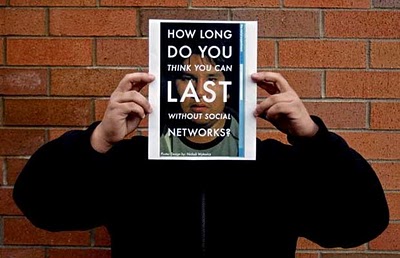
More than 600 teens from a high school in Washington State recently conducted an experiment in which they quit social media-use and texting for one week. Thanks to teacher Trent Mitchell who came up with this “Social Experiment” (Theme: “What was life like in 1995?”), kids learned to communicate the “old-fashioned” way: by calling friends and parents on the phone and actually speaking. Many of the teens had never spoken to friends on the phone before, and found that their friends were awkward conversationalists:

But [Cole Sweeten, 17] likes getting calls. He prefers a real “Hey, how are you?” to a “Hello” text with a smiley face. “People sound different when they’re on the phone,” he said. “It’s emotion, not just little lines.”

Another teen, Eimanne El Zein, 17, reported that it felt “weird” giving it up, but that each day got easier and she was able to take more time for exercise, like running with her dogs, something she never had time to do when Facebook was in her life.

Advice from 16 year-old Nicholi Wytovicz:

…activities such as shooting hoops or watching basketball are better distractions than ones that take 10 or 15 minutes, he said. “Do something that fills time in large segments,” he advised.

Read the whole article here: Teens Go Old School, Quit Social Media

Photo is from the article: Caption: “High school student Javier Caceres holds up a sign promoting ‘The Social Experiment’.” Photograph by: Erika Schultz, McClatchy-Tribune News Service

“Creative Play Makes for Kids in Control”

By , February 27, 2008 9:01 pm

Tomorrow morning (February 28, 2008) on National Public Radio’s Morning Edition, a story will air that is a natural extension of the NPR piece that I wrote about on February 21st in my post: Imaginative Play and Cognitive Function. According to the February 21st piece, children today no longer engage in imaginative, creative play. Unfortunately it turns out that imaginative play is essential for the formation of self-control and self-regulation. These are obviously very important skills in life and are a more accurate predictor of success in school than is IQ.

Tomorrow’s NPR story, Creative Play Makes for Kids in Control, describes a preschool program based on the work of Russian psychologist Lev Vygotsky, entitled “Tools of the Mind” (currently being implemented in Colorado, Massachusetts, New Jersey, New Mexico, and Oregon). The program was developed by Dr. Elena Bodrova and Dr. Deborah Leong of the Metropolitan State College of Denver.

According to the description of the program on the Metropolitan State College of Denver website, Lev Vygotsky believed that

… until children learn to use mental tools, their learning is largely controlled by the environment: they attend only to the things that are the brightest or loudest and they can remember something only if has been repeated many times. AFTER children master mental tools, they can become in charge of their own learning by attending and remembering in an intentional and purposeful way. Similar to how using mental tools transforms children’s cognitive behaviors, they can also transform their physical, social and emotional behaviors. From being “slaves to the environment,” children become “masters of their own behavior.” As children are taught and practice an increasing number of various mental tools, they transform not only their external behaviors, but also their minds, leading to the emergence of higher mental functions.

Alix Spiegel’s NPR report describes a visit to the Geraldyn O. Foster Early Childhood Center in Bridgeton, N.J. where the Tools of the Mind program is being implemented for preschoolers. The point of the Tools of the Mind program is to intensively build “executive function” (ie. “self-regulation”) skills. Please read the NPR transcript for a detailed description of the activities observed at the center. It is quite interesting.

Adele Diamond, executive function researcher and professor of developmental cognitive neuroscience at the University of British Columbia, has observed and studied the Tools of the Mind program (she is in no way affiliated with the program). Here is her description of the first time she observed a Tools of the Mind class:

“I was totally blown away. The kids were sitting together working quietly. It was like a second-grade classroom instead of a preschool classroom. I couldn’t believe it.”

Ms. Diamond conducted a study following 147 preschoolers for two years. Half the children were in enrolled in a Tools of the Mind class, the other half were enrolled in a regular preschool curriculum. After two years, the children were all given an executive function assessment. The results? The regular school kids performed roughly “at chance” while the Tools kids did much better (about 85% correct).

Could reduced executive function skills be a contributing factor to the rising number of kids diagnosed with ADHD (Attention Deficit Hyperactivity Disorder)? Ms. Diamond and a few other researchers think so. Professor Diamond says:

“I think a lot of kids get diagnosed with ADHD now, not all but many just because they never learned how to exercise self-control, self-regulation, the executive functions early.”

This is really fascinating to me, but sad. How could today’s children have lost all their natural and apparently important imaginative play behavior? Why do we have to have programs like Tools of the Mind to help these children self-regulate?

Is it because today’s kids spend much of their free time watching TV, playing video games and taking formal, adult-lead instruction for sports or other extra-curricular, “enrichment” activities? That’s what executive function researchers seem to think.

+++++++++++++++++++++++++++++++++++++++

Be sure to listen to the story tomorrow morning (February 28) on NPR’s Morning Edition, or check the transcript page for a link to the audio version.

Links:

Metropolitan State College of Denver

Tools of the Mind Program

Lev Vygotsky

++++++++++++++++++++++++++++++++++++++++

Photo courtesy of morguefile.com and photographer tangle_eye.

Imaginative Play and Cognitive Function

By , February 21, 2008 3:31 pm

(

On NPR’s Morning Edition this morning was a VERY interesting story (“Old-Fashioned Play Builds Serious Skills“) about how children’s play has changed in the last century. Instead of engaging in self-directed, imaginative, improvised play, play has become centered around toys and the latest movie or TV show: “Essentially, instead of playing pirate with a tree branch” they play “Star Wars with a toy light saber.”

Commercialization is only partly to blame, as child safety has become more of a concern in recent years. Parents are now more reluctant to let their children run loose around the neighborhood. They enroll kids in structured, adult-lead activities.

This change in play-habits has actually changed children’s brains according to researchers. Imaginative play helps kids develop what is known as “executive function,” which is a cognitive skill necessary for self-regulation (controlling emotions and behavior, resisting impulses, and exercising self-control and discipline).

Read this interesting excerpt from the NPR piece:

We know that children’s capacity for self-regulation has diminished. A recent study replicated a study of self-regulation first done in the late 1940s, in which psychological researchers asked kids ages 3, 5 and 7 to do a number of exercises. One of those exercises included standing perfectly still without moving. The 3-year-olds couldn’t stand still at all, the 5-year-olds could do it for about three minutes, and the 7-year-olds could stand pretty much as long as the researchers asked. In 2001, researchers repeated this experiment. But, psychologist Elena Bodrova at the National Institute for Early Education Research says, the results were very different.

“Today’s 5-year-olds were acting at the level of 3-year-olds 60 years ago, and today’s 7-year-olds were barely approaching the level of a 5-year-old 60 years ago,” Bodrova explains. “So the results were very sad.”

According to executive function researcher, Laura Berk: “Self-regulation predicts effective development in virtually every domain.” In fact, good executive function is a more reliable predictor of success in school than IQ. Poor executive function leads to high dropout rates, drug use, and crime. Of course there must be a middle ground here, but the better a child’s ability to self-regulate, the better they will perform in school, and in life.

So here is yet another reason to turn off the TV, ignore the terrible whines, agonizing howls of boredom and claims of inhumane parental treatment and see what happens. They just might surprise you with the games they come up with on their own. And…they will be improving their executive function skills!

I urge you to listen to this fascinating NPR piece (7 min 50 sec), or at least read the online transcript.

+ Some suggestions for activities that promote self-regulation:

(from researchers Deborah Leong, professor of psychology at Metropolitan State College of Denver, Elena Bodrova, senior researcher with Mid-Continent Research for Education and Learning, and Laura Berk, professor of psychology at Illinois State University, found on the transcript page of the NPR website):

- Play “Simon Says”

- Encourage “complex imaginative play” (child plans and acts out scenarios, invents own props, etc. Best if play lasts for several hours)

- Activities that require planning (the examples given are: games with directions, patterns for construction, recipes for cooking)

- Read storybooks with your children

- Encourage children to talk to themselves (“fosters concentration, effort, problem-solving, and task success”)

+ A related Unplug Your Kids post: Let Your Kids be Bored

(Photo (taken in Madagascar) courtesy of Wikimedia Commons and photographer Harald Kreutzer.)

Norwegian Medieval Tech Support

By , July 13, 2007 1:50 pm

My morning, my precious free-time during naptime has been wasted!! I have spent all morning trying (unsuccessfully) to set up my new wireless printer to my Mac Airport Network and this is exactly how I feel:

The Dangerous Book for Boys (Conn & Hal Iggulden)

By , June 26, 2007 7:53 pm

There has been a lot of press and controversy surrounding this book. I first heard about it in an interview with one of the authors on public radio’s On Point (click here to listen). I found the interview to be vaguely annoying, in part due to one of the “guests,” but I also felt that the moderator was not handling things well either. However, the subject matter and theory behind the book sounded so interesting that I absolutely had to check it out. It seemed to be fitting for our unplugged family, and for Unplug Your Kids.

This book is coauthored by two British brothers who wanted to share with the world the activities that they enjoyed, and subjects that had fascinated them as children. According to the interview I heard, the authors are frustrated with plugged-in children, interested only in x-boxes, computer games and TV.

The book soared to the top of the best-seller list in England and now is climbing steadily here. Apparently certain subjects were altered to appeal to the American market (ex. cricket was removed, baseball was added). It is really sort of an encyclopedia of activities and knowledge “for boys.” The “for boys” part is what seems to have stirred up all the controversy.

Call me a wimp, but for better or worse, I am a very non-confrontational person and I really don’t want to get into a feminist, nature vs. nurture, girls vs. boys, or any other kind of debate here or anywhere else. All I can say is that the title does not bother me in the least. Might some girls like this book? Yes. Might some boys NOT like this book? Yes. Could/should the authors have called it something else? I don’t know. End of subject. I want to talk about the book, not the controversy.

This book is a bit of an encyclopedia, or guidebook, to certain activities and knowledge that might be considered lost on today’s youth. Even the cover and marbleized end papers of the book recall a bygone era.

The introduction is wonderful and explains the whole premise of this book: unplug your kids! Here is the first paragraph:

“In this age of video games and cell phones, there must still be a place for knots, tree houses, and stories of incredible courage. The one thing that we always say about childhood is that we seemed to have more time back then. This book will help you recapture those Sunday afternoons and long summers-because they’re still long if you know how to look at them.”

Here, here! I so agree!

As for the rest of the book, it contains an odd array of activities (for example: Making a Periscope, Coin Tricks, Charting the Universe, Making a Battery, Marbling Paper, Secret Inks, Making Crystals, and Making Cloth Fireproof) and very diverse information (ex. Famous Battles, Navigation, The Fifty States, Baseball’s Most Valuable Players, The Rules of Rugby, Latin Phrases Every Boy Should Know, Books Every Boy Should Read, Navajo Code Talkers Dictionary, and The Seven Wonders of the Ancient World). There is even a brief, two page section on advice about girls which might offend some, but I found quite amusing (for example: “Avoid being vulgar. Excitable bouts of windbreaking will not endear you to a girl…”).

I have spent quite a few evenings reading this book in bed, and have learned a lot. It is really fascinating to me! The book is too advanced for my just-turned-5-year-old boy and also for my 6-almost-7-year-old-girl. We could maybe try a few of the activities together, but they won’t be reading it cover to cover for a while yet.

When they are older it will definitely be a fun reference for them. We’ll skip the sections on “Hunting and Cooking a Rabbit,” and “Tanning a Skin,” but some of the other information and activities will be perfect later on down the road.

The whole point is simple: kids should be out in nature and experiencing life, not sitting in front of a screen. The aim of this book is to provide a little non-preachy inspiration and some fun ideas for things to do with your kids that don’t involve a screen or a joystick.

If you are at all concerned about the political correctness of the book, or the suitability of any of the suggestions or information, then I would advise you to check it out of the library before buying it. Make sure that you are comfortable with it and that it is right for you.

I, however, love it and think it will be a fun book for us.

Blog Widget by LinkWithin

Panorama Theme by Themocracy