
Picture Books That Entertain ME (…oh, and my toddler too…)
 Comments (10)
 Have you ever fallen asleep while talking out loud?
I have and it happens most often when I am putting my three year-old to bed, reading her a bedtime story.
My voice gets softer, my words become garbled and trail off, my mouth gapes, my eyes roll up into my head, my neck flops, and just as I begin to drool on my daughter’s head (I know I am painting quite an attractive picture) - I am rudely brought to attention by an indignant cry of “WAKE UP MOMMY!!”
Maintaining my eyes focused and the words flowing freely is absolute torture! An exhausted mommy at the end of her day + warm toddler on lap + boring book = SLEEEEPPPP…….zzzzzzzzzzzz.
Let’s face it. Some young children’s books are downright BORING. What my three year-old loves, is often mind-numbing for me. Even things that seem sweet and charming and lovely when I am awake, are hideously horrible to read when all I want is to have my head on a soft, downy pillow.
I spend a lot of time reviewing books that my children like, but in this post I want to focus on me. ME ME ME ME - it’s all about ME!!!!!!
Here are a few books that I recommend for those extra-tired bedtime reads:
FUNNY
- Anything by the wonderfully talented and funny Sandra Boynton. Cute pictures, quick-paced rhyming text, a sense of humor (and mercifully short). One of my favorites is Hippos Go Berserk
 which always makes me laugh out loud (kind of reminds me of my college days, or is that TMI?). In fact we read it last night, which is what inspired this post.
- Once Upon a Time, the End (Asleep in 60 Seconds)
 by Geoffrey Kloske. Hilarious! Mr. Kloske gets it about wide awake kids and parents who are oh so desperately tired. Just look at the cover, it says it all!
Once Upon a Time, the End retells popular fairy tales EXTREMELY (and very amusingly) briefly. Each tale ends with a not-so-subtle message to the listening child to “GO TO SLEEP!” My older children adore this book too. They laugh out loud, but they know when I reach for it as a bedtime reading choice, that I mean business about getting out of there and into my own bed as quickly as possible.
- Pigsty
 (written and illustrated by Mark Teague), a fast and amusing read about a typical messy boy who won’t clean his room. Mom finally gives up nagging and lets him live with his mess - and the pigs who happily move into his room. The plot and illustrations amuse me, plus I am always hopeful that this story might inspire my children to clean their own personal pigsties.
- Antarctic Antics
 by Judy Sierra, a collection of funny, informative poems about penguins. These clever verses make me laugh and alleviate any Mommy Guilt at rushing the bedtime process, since they are actually quite educational.
LIVELY
- Chicka Chicka Boom Boom
 (by Bill Martin Jr., John Archambault, and Lois Ehlert) and Brown Bear, Brown Bear, What Do You See?
 (Bill Martin Jr. and Eric Carle) are examples of very lively, almost musical books. While not really inherently interesting for adults, I find the strong, sing-song rhythm of the text of these stories helpful in keeping me interested long enough to make it through without falling asleep. Tap your foot, slap your knee, play a maraca to the upbeat tempo of the words.
 - Mr. Brown Can Moo! Can You? (Dr. Seuss) is another book with a strong beat to its text, plus it lets you exercise your performing arts skills when you demonstrate to your children all the strange noises you (and Mr. Brown) can make. It’s hard to fall asleep while imitating a hippopotamus chewing gum.
MINIMAL WORDS/INTERESTING PICTURES
 by the Global Fund For Children (interesting pictures of babies from around the world), and Baby Animals of the Southwest
 by Rising Moon Editors (not your usual baby cows and chickens here).
- If you think can make it through the entire alphabet or the numbers 1 through 21, try Alphabet City
 (a multiple award-winner, including Caldecott) or City by Numbers
 both by artist Stephen T. Johnson. These books have wonderful photographic-quality illustrations of typical city scenes in which a letter (or number) can be found in the natural shape of a detail. It is a fascinating new way of looking at the world that captures my attention, even when sleepy. The cover art explains it best, what do you see here?
- Look-Alikes: The More You Look, the More You See!
 by Joan Steiner is another amazing visual choice. Be careful though, there is so much to see in this book that it could go on all night. When you are exhausted, use this book wisely. Tell your child to find one particular item in each photo, then you’ll be much better off. I guarantee that you will find new objects in each photograph every time you look at this book (keeps it interesting for parents).
- And of course when all else fails, don’t feel bad about resorting to the old tricks of paraphrasing text and turning more than one page at a time! WARNING: Won’t work with older kids. Good Luck! ;)
PS. What tricks do you have for staying awake at story time? What picture books entertain you?


 . I bought the first two of the set of four for my 6 year-old son who was in need of some interesting reading material.
 and other phonics-style readers are too easy and boring, but full-on chapter books are a bit too hard and could lead to frustration.
 ,
,  ,
,  , and
, and  . We’ll definitely be trying another set soon, especially since they are all currently part of the Amazon 4-for-3 promotion (that means you can get all four books in a series for the price of three).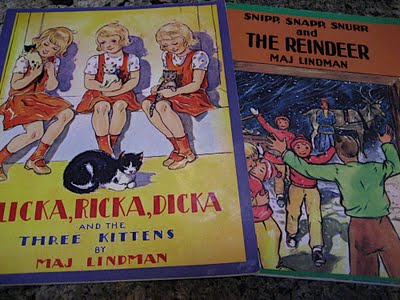
 and
and  . That post reminded me of Maj Lindman’s two lovely series: Flicka, Ricka, Dicka and Snipp, Snapp, Snurr.
 series).
 , and
, and  (which is harder to come by).
 books by Rebecca Caudill that I
  by E. Richard Churchill, Louis V. Loesching, and Muriel Mandell.



 Themocracy