Posts tagged: Book Recommendations

Chapter Books Suitable for Extra-Young Readers (Book Review - Part 2)

By Mom Unplugged, September 17, 2008 9:58 pm

With 10 comments and 135 page views so far, it seems that people really liked the first post in my new Chapter Books Suitable for Extra-Young Readers series! Perhaps I shall have to make this a regular weekly feature at Unplug Your Kids rather than simply stop at the three posts that I had in mind. I’ll certainly run out of ideas eventually, but I do have quite a few to share.

If you are interested in this subject, then I urge you to read all the wonderful comments I received last week on Part 1. Many of you left suggestions of “nice” chapter books that you or your children have enjoyed, and I am so grateful for the helpful input! You even reminded me of a few that I had enjoyed as a child and forgotten about. Thank you!

My plan for this week was to mention another book (again, part of a great series) that I was lucky enough to discover at the thrift store:

Happy Little Family (Fairchild Family Story)by Rebecca Caudill

My children fondly refer to this series as “The Bonnie Books.” When we are reading one of these at bedtime, they shout “Let’s read about Bonnie!!!”

The books are about a family of five children and their poor but happy life in the mountains of Kentucky at an indeterminate era (early 1900′s judging by the autobiographical aspect and the fact that author Rebecca Caudill - real name: Mrs. James S. Ayars - was born in 1899).

The series is about the whole family, although it does focus mostly on 4 year-old Bonnie, the youngest of the five Fairchild children. My two oldest children are endlessly amused by the similarity between Bonnie and their own little two and half year old sister.

Happy Little Family is the first book of this series of four Fairchild family stories. The books are very reminiscent of the Little House series: horse-drawn wagons, the excitement of a pair of shoes or a trip to town, a one room school house, adventures in the woods… but no prairie since this is Kentucky.

Plus, while the Little House books do have a few suspenseful episodes that might be difficult for particularly young and sensitive types to enjoy, we have read two of the Fairchild series so far, and I cannot recall anything remotely frightening taking place in either of them.

Book 1 is Happy Little Family . It consists of various amusing, sweet, and simple adventures of the Fairchild children.

Book 2, Schoolhouse in the Woods, has a more specific theme: a Fairchild family school year in their one room school house, and most importantly - little Bonnie’s very first year of school. (By the way, the school “year” only went from August through Christmas. In January and February the weather was too snowy to make the long walk to school, in March and April it was too rainy, and May through July were busy times on the farm and the children had to stay home and help.)

By popular demand, I am on my way to order Book 3: Up And Down The River

Each of these books is around 120 pages long. Type-face is medium, and there are 5 chapters in Happy Little Family, and 7 in Schoolhouse in the Woods . This series is definitely for more advanced readers than Cynthia Rylant’s Cobble Street Cousins series that I reviewed last week, however I think it might be a small step below the Little House books.

These are also an excellent choice for a sweet read-aloud and my 6 year-old son enjoys them as much as my 8 year-old daughter.

Here are the books in order, but they needn’t be read in order:

Book 1: Happy Little Family
Book 2: Schoolhouse in the Woods
Book 3: Up And Down The River
Book 4: Schoolroom in the Parlor

If you prefer a visual, here are the covers!

Please come back next week for Part 3 of this series!

AN AFTERTHOUGHT: Rebecca Caudill also wrote one of my favorite childhood easy chapter books (I loved it so much that I kept it and it now resides on my daughter’s bookshelf!): The Best-Loved Doll. This is a shorter and much easier chapter book, more like Cobblestreet Cousins in difficulty. It deserves it’s own post one day, but I thought I should also mention it here.

Chapter Books Suitable for Extra-Young Readers (Book Review - Part 1)

By Mom Unplugged, September 11, 2008 3:06 pm

My oldest daughter (now just turned 8) is a really good reader and has been reading at chapter book level for quite some time.

Since she started reading so well at a young age (6) and is also a somewhat sensitive child, I found it difficult at first to find books that were challenging enough, but not scary or upsetting. She was ready for upper level reading, but not for mature or even remotely suspenseful themes.

Of course everyone knows that the The Little House series is wonderful (although beware, there are a few scary episodes). Since I adored those books as a child (and I am a terminal packrat) I kept all my old Little House books and gave them to my daughter.

I also kept some other wonderful classic books from my childhood, but at the time, they were a bit beyond my daughter’s comfortable reading skill level: Heidi, Rebecca of Sunnybrook Farm, the Anne of Green Gables series, the Emily books (my old copies are the ones my mother read and loved as a child in the 1930′s!), The Borrowers series…etc.

So once the Little House books were all read, what then? We only have one bookstore in town and as it is very small, the choices there are limited. I began looking online, and scouring the local thrift stores.

I had some great thrift store luck! My first find is the subject of today’s post:

The Cobble Street Cousins series by Cynthia Rylant

These are very easy first chapter books about nine year-old cousins Lily, who wants to be a poet, Tess, who wants to be a Broadway star, and Rosie, “who wants a little cottage with flowers by the door.” The girls share some happy, innocent adventures while spending a year sharing an attic bedroom in their Aunt Lucy’s house.

Cynthia Rylant immediately piques every young girl’s interest in the first page of each book by explaining that the cousins’ parents are all ballet dancers and are off on a world tour for a year. What young girl wouldn’t want ballet dancing parents? Your girl will most likely be hooked from then on!

The six books in the series are each only a bit over 50 pages long (except for Wedding Flowers which is a bit longer) and are quite suitable for beginning chapter book readers. The type-face is fairly large and the chapters (between 3 and 6 depending on the book) are each short enough to accommodate young attention spans.

My thrift store find was Some Good News, which is actually Book 4, but the books can really be read in any order. It was a perfect choice for my then 1st grade daughter. Since she loved it so much, I ordered the other four online and she devoured them all.

The Cobble Street books would also make pleasant read-alouds for children not quite ready to read them on their own.

Here are all six titles in order:

Book 1: In Aunt Lucy’s Kitchen
Book 2: A Little Shopping
Book 3: Special Gifts
Book 4: Some Good News
Book 5: Summer Party
Book 6: Wedding Flowers

Tip: These are currently part of Amazon’s 4-for-3 promotion, so if you like the series and want to order online, you could get 4 books for the price of 3!

Next week I’ll publish Part 2 of this post: another wonderful discovery of nice chapter books for girls.

UPDATE: Here is the link to Part 2.

Literary Eye Candy (Beautiful Fairy Tales!)

By Mom Unplugged, June 18, 2008 7:00 am

Anyone who has paid any attention at all to my children’s book recommendations might have noticed that illustrations are very important to me. In fact, I have an illustration prejudice. Most of the books I review are classified in the “exceptional illustrations” category because that is what I like. I confess that if a children’s book is well written but I find the illustrations unattractive, I usually think less of the book.

Because of this, we have some really lovely books that literally take my breath away every time I open them up. Just like a gorgeous man with a substandard IQ - who cares about literary quality when the pictures are that incredible to look at! (Just kidding of course…)

If you share my prejudice, then read on!

  • Lovely illustration tip number one: Any fairy tale illustrated by K.Y. Craft or Paul O. Zelinsky will be spectacular in an ornate, Renaissance painting type of way (my personal weakness).
  • Lovely illustration tip number two: Find a book you like the look of on Amazon, and then follow the “customers who bought this also bought” and “what do customers ultimately buy after viewing this item” links, or even the Listmanias in the sidebar, to discover other gorgeous books. How does Amazon “know?”
  • Lovely illustration tip number three: Did I mention K.Y. Craft?

In my mind, fairy tales (classic and not so classic) MUST be sumptuously illustrated. If they are not, or worse - if they are “Disneyfied” (another prejudice on my part), then forget it.

Here are some that we have and enjoy. Be advised that I consider these books to be for older children (ages 5 and up?) because they are very “wordy.” However, you could share them with younger children if you paraphrase the text and just focus on the pictures.

Also, I don’t want to spend a lot of time analyzing the literary value, so not a lot of talk about the text this time. The point here is that the stories are fine, but the illustrations are superb:

Sleeping Beauty by K.Y. Craft is a rich feast for the eyes. The story is pretty much as I remember it from my childhood. The illustrations make it spectacular. To see more of the illustrations, please look at K.Y. Craft’s Sleeping Beauty page on his website.

+++++++++

Cinderella by K.Y. Craft. Of course there are many versions of Cinderella around the world, but this is the one I remember from my childhood here in the US. By the way, I WANT Cinderella’s dress. Wouldn’t it look lovely on me as I browse the produce section at Safeway? K.Y. Craft’s Cinderella page.

+++++++++

King Midas and the Golden Touch as told by by Charlotte Craft and illustrated by (you guessed it!), K.Y. Craft. Again, very traditional story which I like, and sumptuous illustrations. In this book I covet Aurelia’s (the daughter’s) hair. Glossy chestnut ringlets of course. Actually, I want all the hair from all of these K.Y. Craft fairy tales. How come no one has straight hair? I guess that’s why they call them “fairy tales” right? If they were real, they’d all have straight hair and bad skin. More King Midas illustrations.

+++++++++

The Twelve Dancing Princesses as told by Marianna Mayer and illustrated by K.Y. Craft. This is a classic fairy tale that was unknown to me before discovering this book. Apart from the dresses and the ringlets, I like the messages of strong women and overcoming class barriers. Be sure to look at the illustrations on K.Y. Craft’s Twelve Dancing Princesses page. I think this is perhaps the best illustrated of all that I have mentioned so far.

++++++++

Rumpelstiltskin by Paul O. Zelinsky (adapted from The Brothers Grimm). Very true to what I remember, and illustrations “worth their weight in gold!” Visit Paul O. Zelinsky’s Rumpelstiltskin page to see more. A Caldecott Honor Book.

+++++++++

Rapunzel by Paul O. Zelinsky. Lovely, Renaissance-like oil paintings. The classic Rapunzel tale. Boy, do I want HER hair! One potential word of warning for parents here though: there might be an awkward moment if you have to explain why Rapunzel’s dress grows “tight” around the waist after she marries the visiting prince in a secret ceremony in the tower. My kids didn’t notice a thing, but if you fear this is more detail than you want to get into, then be sure to borrow the book from the library first and read it yourself. Visit Paul O. Zelinsky’s Rapunzel page to see more art. A Caldecott Medal Winner.

+++++++++

The Magic Nesting Doll by Jacqueline K. Ogburn and illustrated by Laurel Long. If I had to choose one of these books as my favorite for the illustrations it would have to be this one. There is a level of fine detail and delicateness to these illustrations beyond even what I see in the other books (and those are quite amazing). In an interesting feminist turn around of the normal fairy tale universe, the beautiful girl actually saves the handsome prince! Another plus: The characters have straight hair. No bad skin though. Unfortunately there is no website that I can find for further illustrations, but trust me, they are gorgeous.
“Forgotten Neighborhood Games,” by Scott Strother (Review)

By Mom Unplugged, June 5, 2008 10:06 pm

How many of you know the game of Hopscotch, Red Light Green Light, or Monkey in the Middle? I would guess that most of you parents know these games. But what about your children?

Do you or your children know how to play Exchange, Sardines, or Hot Box? Perhaps not.

That is why every family interested in getting their children outside for some good old-fashioned play NEEDS this book in their library.

Author Scott Strother’s preface reminded me of how much fun I used to have playing spontaneous neighborhood games with my friends.

Two experiences inspired Mr. Strother to write this book: 1) Coaching 6 to 16 year-olds in tennis, and realizing that they had no idea what he was talking about when he referred to some of the very common games from his childhood; and 2) A paper that he wrote about childhood obesity and today’s children’s sedentary lifestyles.

Here are the highlights:

  • Games are classified and organized according to activity level. The first section is Activity Level V, “…games that require the most exercise. These games mainly entail constant running or movement and are highly active.” Each section decreases in intensity until the final, Activity Level I - “…games where mostly walking or limited physical exercise is required. These games are still active and outside, but are not as physically demanding as the others.”
  • There is only one game per page and the information is complete, and very clearly presented. Each game description specifies number of kids, ages, time allotted, space/area, equipment, description (startup, object, and play), and the author’s personal comments.
  • Many of the games require children to determine who is “it.” Do you remember doing that? Well, I suspect that choosing who is “it” might be another lost art. Fortunately Forgotten Neighborhood Games also has a section entitled “Picking the ‘It’” which includes a description of the process, and a few rhymes from which to choose.

When I first began this blog in February of 2007, I had planned on having a “Children’s Games” page where I would write up the rules for various outdoor, neighborhood games. Like the author of this book, I had noticed that most children today are too focused on video games and TV to spend much time outdoors playing active and social games like these. I did write a few game posts which I later eliminated. The task was just too daunting.

Although it is sad that a book like this might be necessary to teach today’s children how to play this way, I am so thankful that Mr. Strother took the time to write this very comprehensive, yet easy to use book. The blog equivalent of Forgotten Neighborhood Games is precisely what I had in mind in back in “the old days” when I first began Unplug Your Kids.

My advice would be to use this book as a reference to find a few games to teach your kids. Or better yet, if your children read well enough, have them explore it on their own. As the author says:

It might take a little effort at first, learning the games and getting other children to play, but once kids start learning these exciting games, they will not want to stop. Do not be afraid to go find kids and coerce them outside for some fun. More and more children from the neighborhood will start to get involved. Everyone will begin looking forward to playing and will meet more often. Instead of sitting around inside, kids can meet each other, make friends, get exercise, and have a ton of fun! This is what childhood is all about. Kids need to get back outside, exercise, and love it…and this book is the guide!

Forgotten Neighborhood Games: Get Kids Back Outside and Loving It! is another useful tool for parents to help get children away from “The Box” and back outside. Deserves to become a classic.

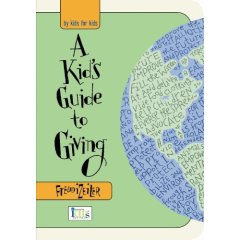
Review: “A Kid’s Guide to Giving” (Freddi Zeiler)

By Mom Unplugged, May 27, 2008 9:44 pm

Those of you who have been visiting Unplug Your Kids for a while, might remember my children’s Heifer International fund raising efforts. They made and sold Christmas ornaments, and earned money from their “Candy Bank” to contribute to my oldest daughter, E’s, class charity fundraising project.

E got so wrapped up in the fun of helping others, that she announced that for Christmas she wanted a book about different charities and what they do. “Santa” brought her A Kids Guide to Giving by Freddi Zeiler.

I promised you a review if we liked it, so here it is - finally!

Ms. Zeiler (age 20 at the time of publication) really began work on this book at age 14 when she became interested in charities, and started researching and compiling notes on different charitable organizations and how they spend their money. Her parents encouraged her to expand her research and turn it into a book to inspire other young people.

This book was just what E was hoping for. The first half discusses why to give, how to choose a cause, types of contributions (money, things, and time/effort), fund-raising ideas, and more. There are also sections on why it is important to know how a charity spends its money and how to avoid scams.

The last portion is a guide to tons of kid-friendly charities arranged by subject (“People,” “Animals,” and “The Environment”). It explains what each charity does and gives contact information, website, breakdown of how each dollar donated is spent, etc.

There is a small section for notes at the end, although my daughter likes to just put a check mark by her preferred charities. The hard cover and fold-over magnetic flap make it appealing in almost a diary, or notebook-like way.

My daughter likes to sit and read it, and I am happy to let her do so. Since this is a guide for children, the charities are comprehensible to children. You will not find yourself having to explain to your 7 year-old what a rape crisis center is, for example.

My children’s “charity of the day” is the African Wildlife Foundation (discovered through this book). They have already “adopted” one animal, a leopard, and are working on raising money to adopt another.

A final note: The recommended age range for the A Kids Guide to Giving, is 12 and up. My daughter is only 7, but she is an excellent reader. In my opinion, this book is suitable for children younger than age 12 provided they have the necessary interest and reading skills.

GREAT REALTED LINK: Topaz Took was kind enough to offer a link (in her comment on my Heifer-results post) to a wonderful website called Doing Good Together, about volunteering together as a family. There is a wealth of information including how to get your family involved in helping others, as well as an interesting resources section (books, videos, and websites arranged by topic and age). Thank you Topaz!

Blog Widget by LinkWithin

Help Pakistan

Panorama Theme by Themocracy