Posts tagged: language learning

TV and Infant Speech Delay

By , June 23, 2009 9:44 pm

I have been a very minimalist blogger lately, popping in once a week to post the Linky for the Unplugged Project. I guess I have been taking a bit of a refreshing blog break. Time and inspiration permitting, I might be up for writing a bit more often than I have been.

So, here is my first TV-related post in a while for anyone interested in television and its effects on children.

Many thanks to my friend Wishy who is always way more up with current news than I am, and who kindly emails me links to any article she thinks might be of interest on my blog! I guess she is my Director of Current Affairs.

Here is Wishy’s latest find: Even Background TV May Delay Children’s Speech. This article is nearly a month old, but that’s how long it took me to get around to writing my post. Oh well.

According this MSNBC article, a new study* has found that for each hour of television exposure (even as background noise), infants heard 770 fewer words spoken to them by adults (a 7% decrease). There was also a decrease in the number and length of children’s vocalizations, as well as child-adult conversation.

The possible explanation for this? Here is the researchers’ conclusion:

“Some of these reductions are likely due to children being left alone in front of the television screen,” the researchers write in the June issue of the journal Archives of Pediatrics & Adolescent Medicine, “but others likely reflect situations in which adults, though present, are distracted by the screen and not interacting with their infant in a discernible manner.”

I would imagine that most mothers have been naturally chatting away with their pre-verbal babies since language first began. But experts now realize that two-way linguistic interaction with adults is absolutely crucial for infant language development.

By the way, one startling fact from this article is that 30% of households have the TV on all the time. Wow!

A final thought: I wonder if too much talk radio would also have the same negative effect on language development. I know when I am trying to listen to the news on NPR, I am not paying a whole lot of attention to what my children are saying either.

This is a good reminder for us all I think.

++++++++++

* The study, entitled Audible Television and Decreased Adult Words, Infant Vocalizations, and Conversational Turns, appeared in the June 2009 issue of The Archives of Pediatric & Adolescent Medicine. Here is a link to the abstract. The full article is also available online with membership, or for a one-time access fee.

++++++++++

(Photo credit: clarita from morguefile.com)

Words - Language Bingo (Weekly Unplugged Project)

By , April 5, 2009 9:50 pm

First of all, I want to send a HUGE thank you to Lynn of Chronicle of an Infant Bibliophile for doing an excellent job of hosting the weekly Unplugged Project last week while I was away on vacation. I really appreciate it and I hope it was fun for you!

We had a lovely time in Mexico. The kids ran around on the beach and swam in the pool non-stop. This was our first vacation with my youngest in tow where I was actually able to relax a bit. My three year-old was finally independent enough to allow me to read two and a half books. What a luxury.

++++++++++

Surprise! We finally got to the Unplugged Project this week. Although I hadn’t picked the theme words for any particular reason, it actually fit in perfectly with what we have been doing lately: learning French.

I haven’t blogged about this yet, but this summer we are all going to France for three weeks where my two oldest children (6 and 8) will attend a language class. I used to live in France, and am determined that my children learn French. This is step one. I’ll write more about it another day.

Anyhow, inspired by this wonderful French bingo game by eeBoo that we bought and love, I decided to make our own version. I designed our own, changeable bingo game for learning lots of French words.

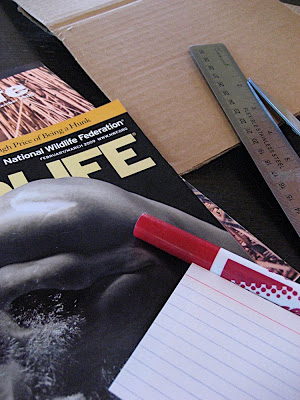
We gathered up some heavy cardboard, card stock, scissors a ruler and some old nature magazines.

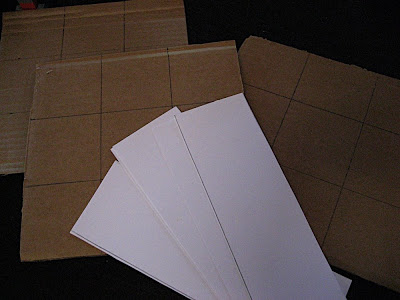
First I cut the cardboard into three equal squares, one for each of my children. My squares ended up being about 8 in. by 8 in. (about 20 cm by 20 cm). It doesn’t really matter how big they are, as long they are square.

Using the ruler, I penciled a grid of nine approximately equal squares on each piece of cardboard. These became the bingo cards.

We cut strips of card stock that were the same height as our rows of three squares, and slightly longer.

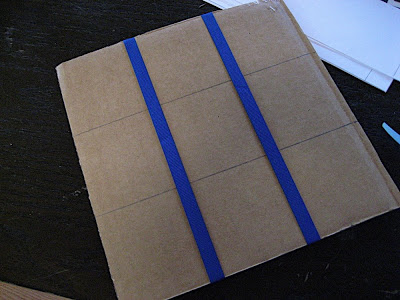
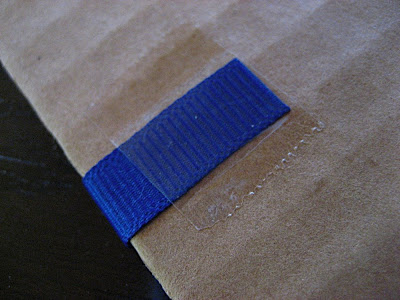
Next we cut some narrow ribbon in lengths just long enough to be slightly wider than the cardboard squares.

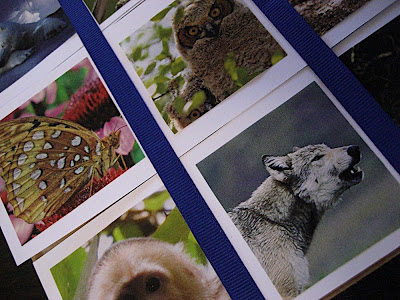
We put one piece across each vertical line on each card (two per card):

Then we taped the end securely onto the back of the bingo card:

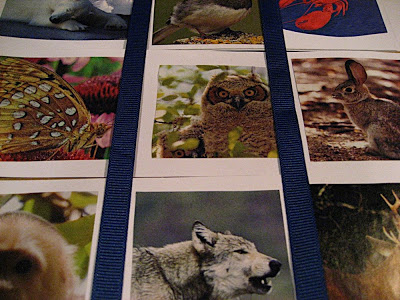
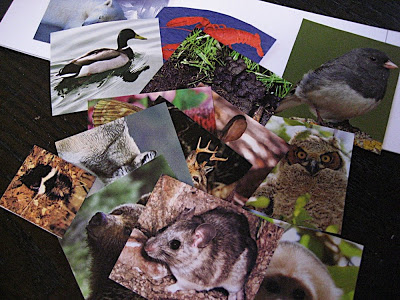
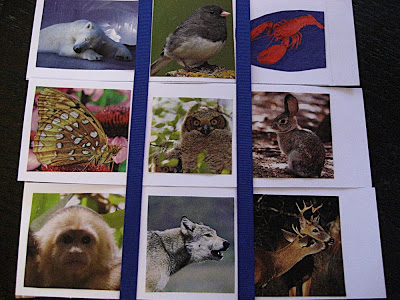
Finally, the really fun part. We searched the nature magazines to find some common animals to cut out, making sure that each animal photo would fit inside one of the nine squares on the card.

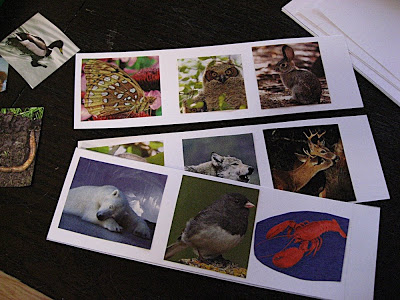
We pasted three animals on each strip keeping enough space between each animal for the ribbon.

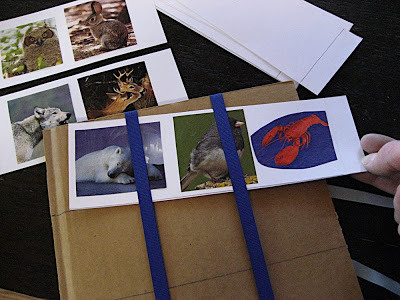
Finally, we slid the strips under the ribbons to fill in the bingo board. The strips pass easily underneath the ribbons and the slightly longer length makes a nice tab for easy insertion and removal.

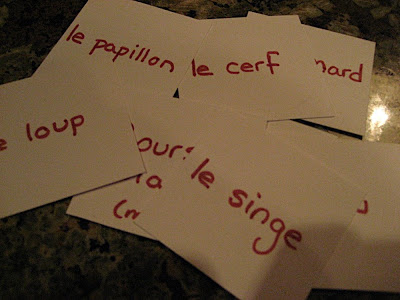
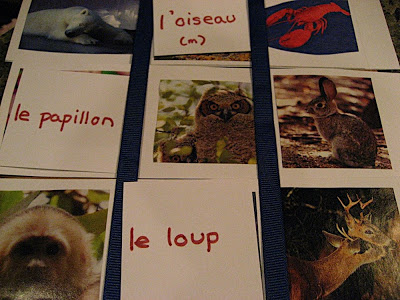
When the boards were done, we cut pieces of card stock into squares that were close to the size of our animal squares. I wrote an animal name in French on each card.

Play proceeds like this:

The cards go into a bag. The caller pulls out a card and says the name of the animal. Whoever has it on their card says “moi!” (me) and places the card on top of the corresponding picture. They also must say the name of the animal in French. The winner is the first one to fill up his or her card and must then say the name of all the animals on their card in French.

One thing that is really fun about this is that you can rearrange the strips so the cards change combinations.

You can also make new strips for other categories of study. We did animals, but you could do words having to do with the home, the body, school - whatever you want! As vocabulary knowledge increases, you can mix the categories or words to make play more difficult.

The picture finding and cutting is fun and also provides an opportunity to learn the words before play.

For more advanced players, you could even do verbs and conjugations.

++++++++++

For those of you who did a word Unplugged Project this week, here is the linky. Please link only if you did a word Unplugged Project. Please link to your project post rather than simply your blog (I am trying build up an easily searchable archive). If you did not do a word project, but want to learn more about how to join in, please read about it here. We’d love to have you!

++++++++++

The theme for next week’s Unplugged Project will be:

Transportation

Have fun!

++++++++++

++++++++++

“#&*@” Spelled Backwards

By , March 28, 2008 9:36 pm

My friend Wishy and I had a good laugh one day when we discovered that a classmate of our daughters was teaching the other children “bad words” by not actually saying the word itself, but by saying it backwards. Wishy’s daughter said to her in hushed tones: “Mom, did you know that “tish” spelled backwards is a bad word?” Further parental inquiry revealed that she knew that “cuff” spelled backwards was bad too.

A recent NPR piece entitled Why Kids Curse, brought this rather amusing memory back to me. Although we wish our children would never learn the “bad words,” it does inevitably happen. Unfortunately when it happens, is commonly sooner rather than later. Many parents seem to have a funny or embarrassing story of a precocious child and inappropriate language. Of course children might pick up bad language at home, but often it is from schoolmates or friends.

The NPR piece relates the funny tale of Yale psychologist Paul Bloom, whose 6 year-old announced one day the words that he had “learned” from overhearing the babysitter on the phone. He and his wife then decided to create an experiment in which they would invent some family swear words to see if their kids picked them up:

“So one of them was ‘flep,’” says Bloom. Whenever someone would bang their foot or hurt their toe, they’d scream “flep” as if it were an obscenity.

The experiment was very short-lived.

“It was a total failure,” says Bloom. “The children looked at us as if we were crazy.”

The reason for this failure? Kids are more influenced by their peers than their parents, according to Harvard psychologist Steven Pinker.

As I am interested in both parenting and linguistics, I found this story to be fascinating from both standpoints. There is more to the piece than what I mention here, so I encourage you to give it a read or a listen if you have a few minutes to spare.

And what on Earth does all this have to do with TV? Well, read on:

A study by the Parents Television Council found that about once an hour children watching popular children’s networks will hear mild curse words such as “stupid,” “loser” and “butt.” The scope and frequency can rise immeasurably with exposure to adult programs and popular music.

That’s the connection!

Link: Why Kids Curse - transcript and audio link (7:07)

(Image courtesy of Wikimedia Commons)

Blog Widget by LinkWithin

Fight World Hunger

Panorama Theme by Themocracy