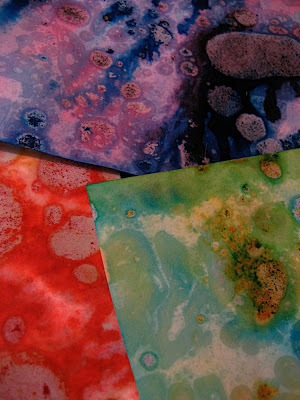
This has actually (unintentionally) been a colorful week for us.
I haven’t mentioned Odyssey of the Mind (OM) here yet, but my friend Wishy and I just discovered it (actually she discovered it) and we dived right in last fall as coaches for our children’s Montessori class (1st - 4th grade). It’s a bit complicated to explain OM in this post, but suffice it to say that the children have to come up with an engineering or creative project entirely on their own. “Outside Assistance” is heavily penalized.
My 8 year-old daughter apparently has the role of a tree in her completely student-created play. She decided she wanted to dye some net green to be her leaves, so she chopped up an old artichoke that we happened to have in the kitchen and boiled the net in it to dye it green. It didn’t work so well. She then tried green food coloring. Not too effective either (I think it would have worked better on a natural fiber). That was all entirely her idea.
Personally I probably would have headed to Walmart for some green dye, or better yet, green net! But of course I couldn’t say that to her - “outside influence.” So, I look forward to seeing what possible solution she comes up with next.
I was so proud of my daughter’s initiative and creative thinking! These Unplugged Projects are more than just a diversion. I believe that they encourage original thought and teach that it is OK to not get it right at first. Just experiment to see what works, and if it doesn’t, then try and figure out how to make it work!
That was a bit of a tangent, but her experiments with dye got me thinking about food coloring and how we could incorporate that into the theme color. I began Googling food coloring and oil because I knew that the two don’t mix and I thought there might be something fun out there. I was quite excited to find this: Marvelous Marbling.
I have wanted to try marbelizing for a long time now. I have fond memories of loving it the time we did it in elementary school. Since the memory has stayed with me that long, it must have made a big impression!
Traditional marbleizing involves oil paint and turpentine. Frankly, I have never had the energy to tackle that. Turpentine - ick. This webpage tells how to marbleize using just food coloring and cooking oil. I had to try it! So we did. I made a few alterations - here is my version.
++++++++++
For this you’ll need a shallow pan that is large enough to fit the paper you’ll be using (I used a nasty old roasting pan), food coloring, cooking oil, white paper (we used card stock - NOTE: thick card stock produces as a nice result, thinner paper tends to get a bit greasy), water and an eye dropper. The eye dropper is optional, but we found it worked better than just pouring.
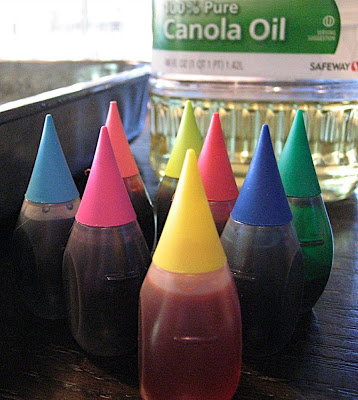
Put just enough water in the pan to cover the bottom (**VERY IMPORTANT!**). As we discovered, if the water is too deep, the color will sink if you work too slowly.
Put about 1/2 tablespoon oil and 1 teaspoon food coloring into a glass (we halved the proportions of the original since we only had tiny bottles of coloring and I didn’t want to use it all up).
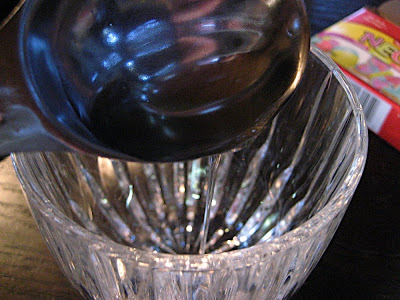
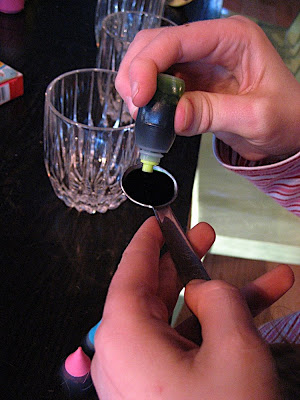
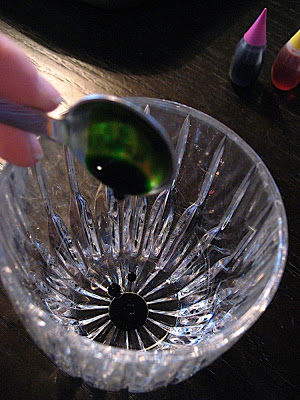
The two ingredients will not be mixed. [NERDY SCIENCE NOTE: Oil and water don't mix due to dissimilar molecular bonds - "like dissolves like" and water molecules and oil molecules are not alike. Read more here: Ask a Scientist - Mixing Oil and Water and here is a good, simple tutorial about solubility and water: Water Tutorial]
At this point, the mixture will look something like this:
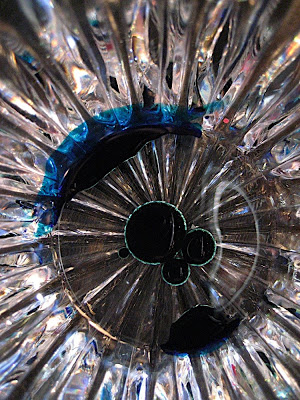
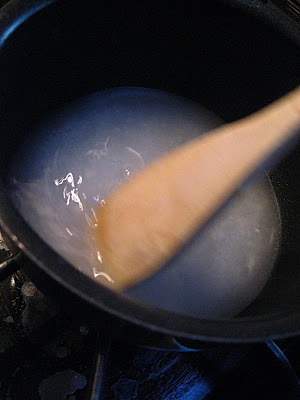
Beat it hard with a fork until well blended. It is like mixing an oil and vinegar salad dressing and will take a few minutes. We experimented with mixing it in a jar and shaking it up. That worked even better, just make sure the top is on tightly (we had a bit of a food coloring disaster the first time my daughter tried it).
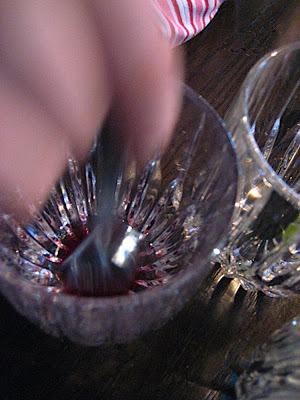
When done, it will look more like this:
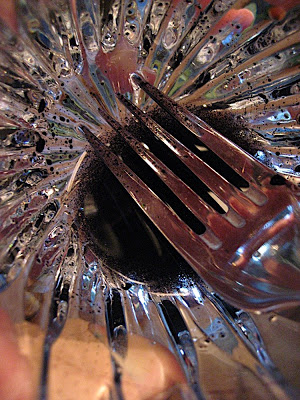
Using the dropper (or gently pouring if you don’t have a dropper), place drops of colors on top of the water. The drops will stay in a blob, or perhaps explode a bit. You can place one color inside another. Experiment.
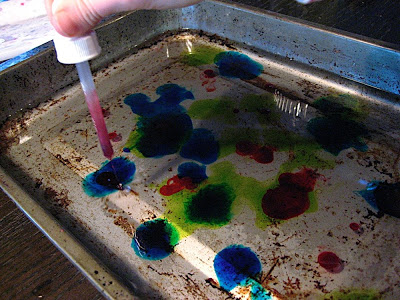
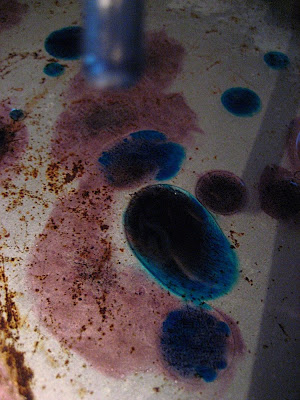
When you have dots of color all over the surface of your water, use a toothpick, or a fork, or a feather (whatever you want to try) to make patterns in the colors. They’ll make blobs and swirls and pretty patterns.
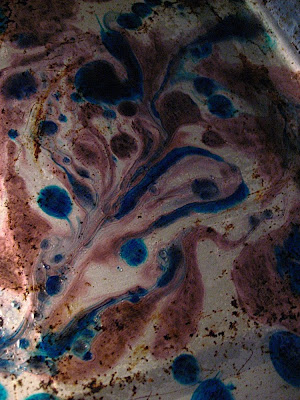
When you are happy with the design, gently place your paper on top of the water. Leave it for a little bit. We waited until the oil started to show through the back of the paper (about 30 seconds?) and then peeled it gently off.
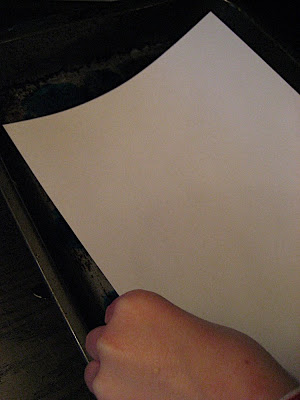
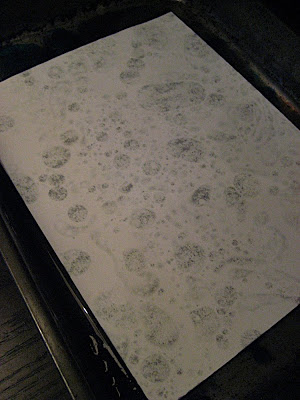
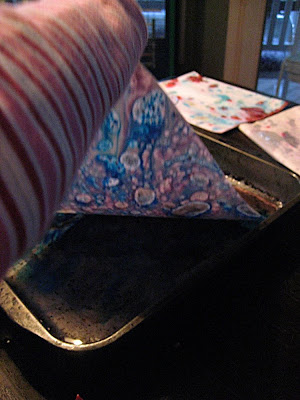
There will be lots of oohs and aahs as the pattern is revealed!
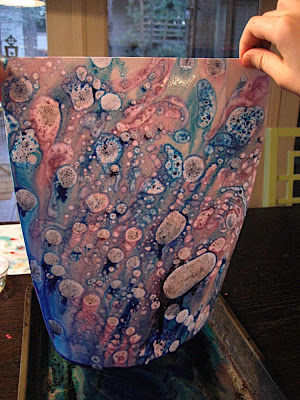
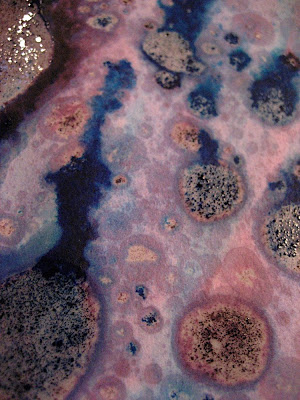
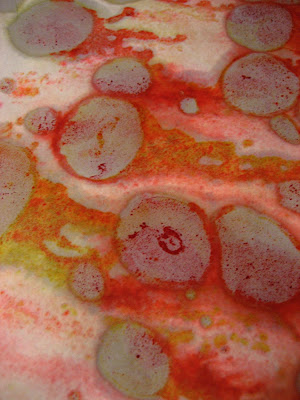
That one reminded me of a medical slide. LOL! Here are is another pretty one:
We even tried hot water vs. cold water. Knowing that molecules move faster in hot water, we wanted to see if anything different happened to our oil/color mix in really hot water. We didn’t see anything too dramatic, but my daughter did note that the blobs converged a bit more quickly. (For more on hot vs. cold liquids, please read my post: Molecules in Motion).
Let the paper dry then use it for cards, wrapping paper, framed art, whatever you want. Ours will become thank you notes.
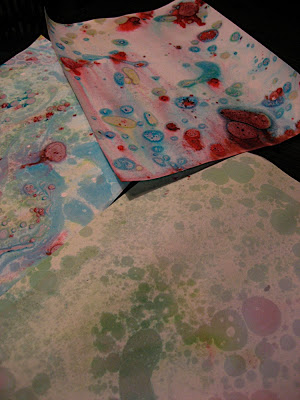
According to my 8 year-old daughter, this is her “new favorite project!”
++++++++++
For more color project ideas, please check out all the links here.
++++++++++
The theme for next week’s Unplugged Project will be:
Float
Hope to see you then! (If you want to join us, please read about how to here.)
++++++++++
(marbelized)

 Comments (2)




 Themocracy